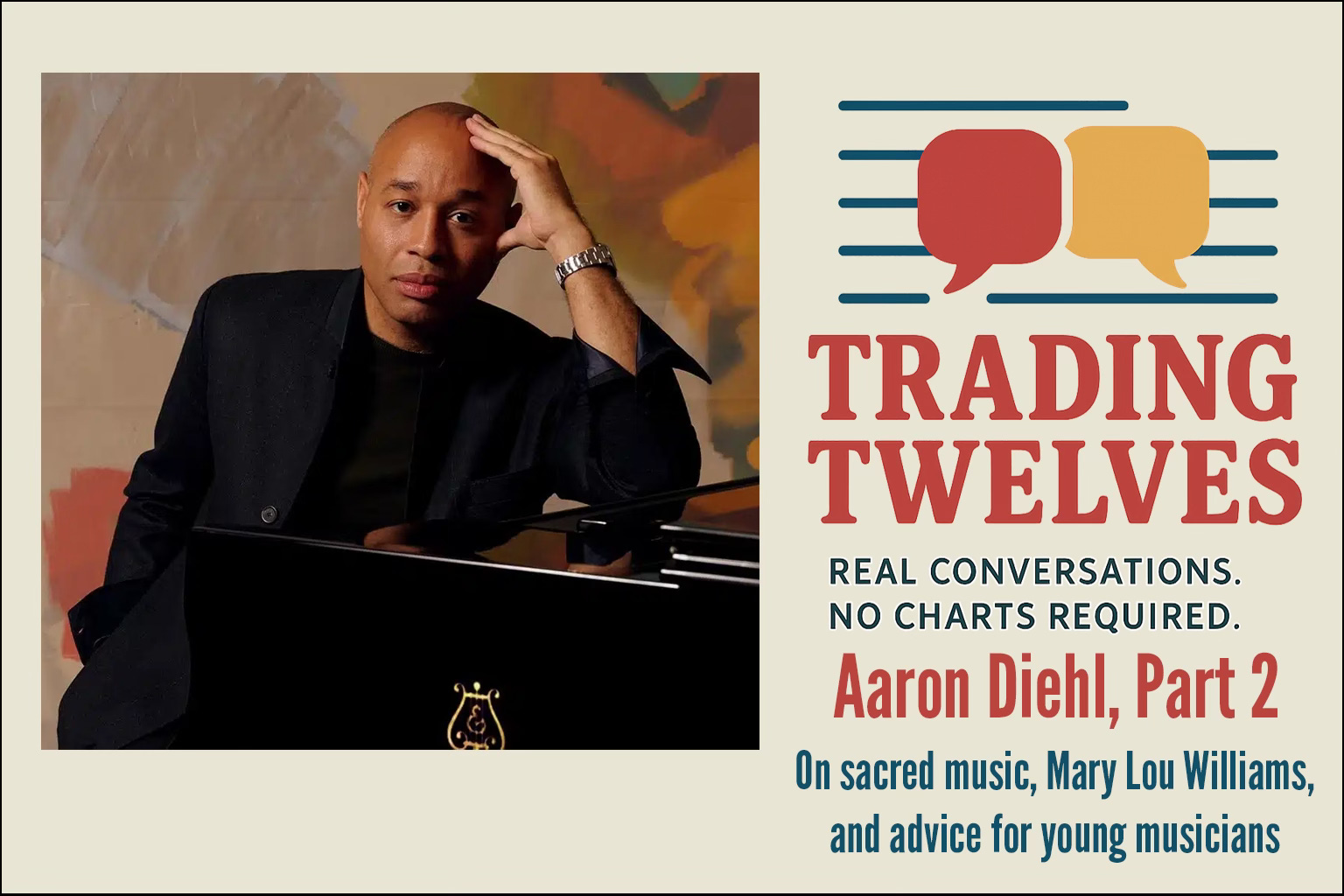
A Conversation with Aaron Diehl Part 2
Pianist Aaron Diehl discusses the music of Mary Lou Williams.
In Part 1, Aaron Diehl shared how his grandfather’s influence and mentors like Mark Flugge and Marcus Roberts shaped his path from classical training to jazz improvisation. Here, we continue our conversation, turning to his work with Mary Lou Williams’ Zodiac Suite, the composers who have deepened his artistry over time, and his perspective on what young musicians need to thrive in today’s landscape.
Q: You have recorded Mary Lou Williams’ Zodiac Suite, one of the under-appreciated suites in jazz. Can you explain your history with this piece and how you came about getting it and performing it?
Aaron:
Before talking about the piece, I believe it’s important to talk about my relationship to Mary Lou Williams through a man named Father Peter O’Brian who was Mary Lou’s manager from the 60s until she died in 1981.
I grew up Catholic and I went to a black Catholic church every Sunday in Columbus, Ohio. That was a big part of my foundation too, playing for the choir, playing for the masses at Catholic school. So when I moved to New York, I started playing for a black Catholic church in Harlem. At Juilliard, there was a Mary Lou Williams concert my first or second year. I wasn’t playing on the concert, but I was attending the rehearsals. There I met Father O’Brian, who was this Jesuit priest. I couldn’t really make out the context of why there was a priest at this rehearsal. It turned out that he was her manager.
A few years later, just by coincidence, I was playing at this church called Saint Joseph of the Holy Family on 125 street and Morningside Avenue and Father O’Brian happened to be a guest priest for the mass one Sunday. After I had played, he said to me, “Oh I remember you from Juilliard. We should do some of Mary Lou Williams’ sacred works here at Saint Joseph.” I had not realized at the time that Mary Lou Williams had converted to Catholicism in the 60s along with Dizzy Gillespie’s wife Lorraine. She had gotten frustrated with the music industry by the late 50s and took a hiatus from music. When she returned, after having this whole spiritual conversion, she started writing music for the church. During that time, she met Father O’Brian, who was a jazz fan and they eventually started working together. That’s how I got to know him.
I didn’t come to the Zodiac Suite until much later. Father O’Brian would occasionally talk about it. Geri Allen had also done a recording of it called Zodiac Suite: Revisited. He was also managing her near the end of her life as well, before he passed in 2015. During the pandemic, I was looking for different projects and I wondered what could be a fun thing to do to kill some time while we were going through that. Sure enough, I found this version that was published in 2011 from a 1945 iteration of the piece that Mary Lou Williams premiered at the town hall of New York City, which was orchestrated for chamber orchestra. Over the pandemic, I had spent quite a bit of time sorting through some of the issues with the orchestration, note errors in the manuscript that didn’t get caught. Hopefully I will have at some point in the future a much better edition with proper markings and articulations.
I was really grateful to Father O’Brian to be introduced to her music through him. Just having that personal connection really did help in terms of my awareness of her. Her music is out there and available but her music is still very much underrated today.
Q: I’d agree with that. The most contexts she comes up in is her being a mentor to Monk and Powell.
Aaron:
Exactly. She was a significant influence on those folks and the community in general. What’s so interesting about Mary Lou Williams is that she developed through all of the eras of the music. She was always pushing herself. She wasn’t stuck in the swing era. She was also interested with what the young people were doing with bebop all the way into the 60s and the 70s. She was always trying to find ways to push her limitations as a musician. That’s really why this orchestration of Zodiac came about. She wanted to learn how to write for a larger scale ensemble and all the great coloring that comes along with that. But she got frustrated with the premiere of that piece and she never revisited that version.
Q: Her contributions to jazz history are definitely underrated. Even in the beginning of the Zodiac Suite, you can hear “Epistrophy” right there in the first track!
Aaron:
Yeah right! That’s “Aries”.
Q: I just have a couple of more questions for you. Do you have any composers that you didn’t appreciate when you were younger that you have come to appreciate as you’ve matured? For me it’s someone like Bach where it was like eating your vegetables as a kid.
Aaron:
It was the opposite of that for me. To this day with this incredible amount of awe and feeling of inspiration. When I heard Bach when I was a kid I thought, “this guy is on some other stuff”. When I heard the Brandenburg Concerti, my parents had a boxset of that and his keyboard concerti, I really wanted to play them. I would say maybe for me, someone like Brahms, who I enjoy, like the Fourth symphony, but I really wasn’t as drawn to his music as I’d come to be drawn to his music now. In fact I bought a book of his piano pieces, intermezzi and trying to play through them and analyze some of what’s going on. But Brahms was incredible.
There’s a composer friend, who has written some music for me, his name is Timo Andres, who is a great composer around my age. I had conversations with him about how to incorporate all of these forces that I love, the black American jazz vernacular into the timbral elements of European music and the sonic elements of orchestration and color. To me, that is something that I’m thinking about more and more. People like Gunther Schuller and John Lewis were certainly trying to experiment with that. Of course, Wynton Marsalis is writing all kinds of concert music, concerti, concerto for orchestra, and symphonies. I think it’s been a source of fascination by jazz musicians since the inception of the music and how to translate this music into a large form where more color and more timbre are available to us. James P. Johnson is another one. It’s hard. It’s a hard vision to realize. You’re talking about two disciplines that have very different sorts of training, living inside of different spaces. I hope one day it truly is realized. It’s like slowly chipping away at the possibility more and more of doing that. I think nowadays, musicians are realizing they have to have more skillsets just to survive. There’s also curiosity from young musicians about different idioms and genres. So maybe there’s more of a space for that now than there was 50 years ago.
Q: What advice do you have for young pianists today?
Aaron:
One is very simple. Truly be engaged in the music which I think is becoming harder and harder today. Everyone is trying to figure out how to survive and to be noticed because that’s how you have to build a career nowadays through social media. Whatever arena you go into, you should really, truly be engaged with the music making. To understand that the journey in doing this is really inward. It’s about self-discovery and how that reflects out to people through the music in a public facing environment. It’s not the other way around. I’m noticing that’s a challenge for a lot of people.
Spend an hour just listening to a record. Listen to something you haven’t heard before internalizing it. What do you like? What don’t you like? What can you use? Having as many references as possible. That’s something I learned a lot from Cécile McLorin Salvant. I’ve always considered myself a capable musician but she has a real sense of how to make connections, not just within music, but within the realm of literature, visual arts, theater, all of the artistic mediums. I think that’s just a special skill. She has a special gift for that but she also works at that. Ultimately, in creating more associations, it’s understanding more the foundations of what makes us human beings and all of our foibles, our triumphs, both individually and as a society. It’s a constant zooming in, wanting to refine your craft, but also a zooming out, seeing the larger picture and how it relates to everything else in the world.