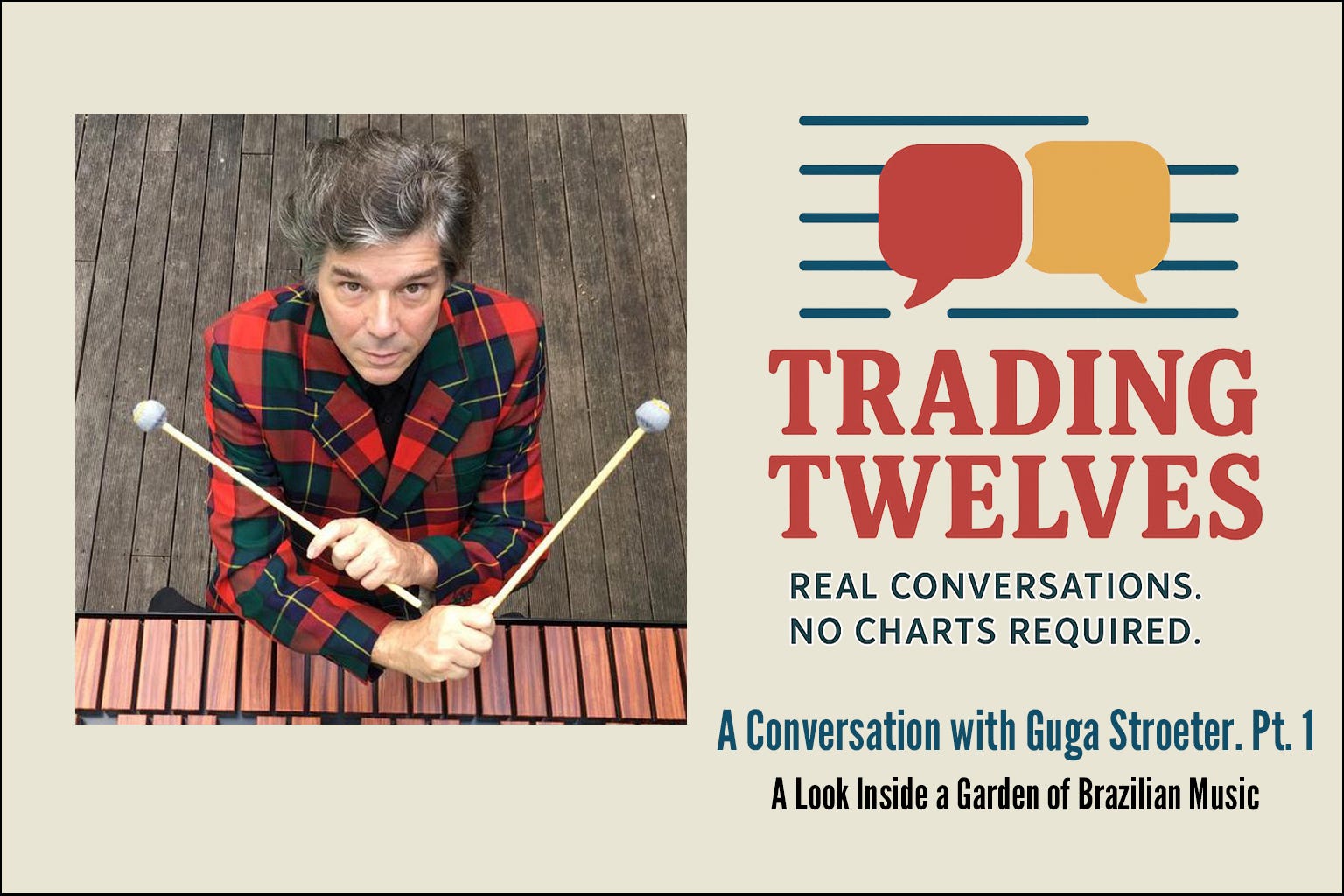
A Conversation with Guga Stroeter, Pt. 1
A Look Inside a Garden of Brazilian Music
In January, my travels across the Americas led me to the front of a “typical mid-century home” in São Paulo, but it became apparent to me that this is no “typical” home. Rising from the horizon of the top of the staircase, trees gradually revealed themselves. There are around 40 different trees in the garden area that wraps in and around the house, with various Brazilian fruit-bearing trees such as jabuticaba, cacau, ambarella, sugar-apple, and starfruit amongst many others. Perhaps this was one of the factors that inspired Guga Stroeter, owner of the house, to name his book A Tree of Brazilian Music.
A friend of Wynton Marsalis, Guga is a vibraphonist by trade, but he is also a producer, music director, former jazz club owner and writer and researcher of Brazilian music. The illustrative poster that accompanies the book is displayed on the wall and is perhaps one of the most impressive trees in the house. It gives a curated look into the growth of Brazilian music from its roots of African, Indigenous and European music spanning across time in all directions toward the modern day. One can see that Brazilian funk artists grow out from the sprawling branch of samba. One can trace the long continuity of concert music in Brazil. It is easy to trace the constant expansion of the many interrelated styles of Brazilian music.
As part of the garden Guga sought to grow when he first moved into the house, there are nine different species of Brazilian bees that are cultivated in little wooden bee hives. With the bees came savvy spiders, harmless to humans, taking advantage of the lack of pesticides and insecticide (given these would be harmful to the bees) to help control the bug population. Each spider has a name, with the most famous being Adelaide — over 3,500,000 views on his Instagram page. Guga joked, “some of my music I have that I’ve made with much love, sometimes only get 12, 14 views on the internet…but she deserves it!”
On the door of Guga’s home studio, there’s a brass plaque for the stage, “Palco Wynton Marsalis” that used to adorn the stage of former club Blen Blen Brasil. The plaque also contains a quote from Marsalis’ 1994 book Sweet Swing Blues on the Road: “When everyone chooses to participate, that’s when the music is beautiful”. This quote illustrates the spirit of the performance space. Built during the pandemic as a recording studio meant to house an audience of 20 to 25 people, this studio quickly transformed into a major hub for music and community.
“Sometimes, we create a music club with our friends. It’s called a Sarau. Sarau is a kind of party where people come to make music from everywhere. We called our group Sarau Brasilis to improve Brazilian singing and songwriting. More than jazz and instrumental music, we are most focused on songs. And this grew. We were 10, 12. Now we are 300, 400.”
All around Guga’s home, he has cultivated a forest of ecosystems, natural and social where even the most unexpected guests, such as Adelaide, or even musicians from all over, can find a place.
Q: How was the process of research for the book you and your friend Elisa Mori organized, A Tree of Brazilian Music?
Guga:
In 1994, I was visiting Europe, and I went to a record store. During this decade, it was very important for us musicians to go to these record stores abroad. In Brazil there were no imports. The law was very protectionist. You could not find imported records anywhere. So, when we traveled, one of our favorite things to do was to buy records.
When I was in Amsterdam, I saw a poster that caught my eye called The Jazz Tree. I bought it for a few dollars and when I went back to Brazil and put it in my house. Whenever people would come over, I realized that many people were looking at this poster and searching it for names they recognized. Even people that didn’t like or didn’t even know jazz. I thought that if people were interested in the jazz tree, searching for musicians, then someone has to do the Brazilian jazz tree.
In 1996, I spoke with a very good Japanese friend called Elisa, who owned a place that rented videotapes. Slowly, we spent the first few years researching, every Monday on her day off. This goes to show how old the project was. It was still in the beginning of the internet, so we didn’t have things like Google, so much of the research was done through reading books.
When we finished it, there wasn’t really much interest in publishing it at the time. There was an internet fever going around. People were constantly telling me to publish it on an internet website rather than as a book. But one person was interested, the man who invited Wynton Marsalis to come to Brazil in 2019, the Director of SESC, Danilo Santos de Miranda.
When it was finally published, the book and the poster, people loved it. Because it’s about Brazilian music, people were able find something they like in it. If not choro, then samba. If not samba, then forró. If not forró then Brazilian rock and roll.
Researching was very good for me as well, in helping to better understand my country and its history. Often we don’t realize that music is one hundred percent attached to historical circumstances. There’s a very beautiful historical flow in the creation of different styles and different artists across time.
What was most important for me to learn is that different people will always like different music. I don’t care to be a judge of what is good and bad. The phenomenon of music is anthropological. When an artist or a style is popular it has to be recognized as something interesting within the development of a nation’s culture.
Q: What are some of the challenges you’ve encountered researching and documenting music across Brazil?
Guga:
Making the decision of who to include in the research and who to leave out is a difficult task. It’s not possible to please everybody. I had to make specific limitations. In publishing it, my intention was to make a tree of Brazilian Music not the tree of Brazilian music. Brazil is a continental sized country, with many different regions and styles from the deep south to the Amazon. I hope that this project can give birth to many others so that someday someone can compile a great archive.
Q: For people who may not be familiar with Brazilian music, can you explain some of, what basic elements lie at the roots of your tree?
Guga:
There are three basic roots of Brazilian history. The first is the native Brazilians. When the Portuguese arrived here, there were more than 1,200 different languages and many different native cultures. This music from this time has not survived much in our popular music today. This music was very important though during the colonial period. During this time, the Portuguese sent Jesuit missions to Brazil to convert the natives to Catholicism. They soon realized that music was the best way to attract people to them, so they invited natives to play music. This kind of music was basically just singing, stepping, and repeated syllables chanted. There were a few instruments such as shakers and flutes.
The next root is the enslaved people. Brazil was the place with the biggest migration of enslaved people in the Americas. During the 15th century, the Portuguese developed sugar cane plantations, and many enslaved people were brought to work on them. From the 15th century up until the end of the slave trade in the 19th century, Brazil received around 5 million enslaved people. For every single enslaved African brought to the United States, 10 were brought to Brazil.
Early on, they were mostly Bantu speaking people from Mozambique and Angola but later in the 18th century, many people from the Yoruba tribes in Benin and Togo, and Nigeria were brought.
The third root is the Portuguese. Since the Middle Ages, the Portuguese have had many religious parties and festivals. The songs from these celebrations were mixed with the African and indigenous music to create Brazilian music.
In the late 19th century, the Portuguese royal family moved to Brazil, escaping Napoleon’s invasion of Portugal. Suddenly, Rio de Janeiro became the capital of a Portuguese Empire that had lands across Europe, Africa, India, and China. When the royal family arrived they brought with them, the music of European nobility, such as waltzes, polkas, mazurkas. High society in Brazil began listening and playing this music, which then diffused out to the poor, who also learned these styles and made different fusions with it.
In the 20th century, when the United States became the most powerful country in the world, with its record companies, its movie industry, American music became very influential in the evolution of Brazilian music with jazz, some gospel, rock and roll, and R&B being incorporated.
Q: You’ve encountered a lot of the music that exists in oral traditions or is passed down from master to student. What is the importance of documenting this music? How does documenting this kind of music through notation or recording change how people subsequently experience it?
Notation is very important, but sometimes we forget that it’s just a code, a very recent code. We have anthropological evidence of instruments from 50,000 years ago, and we’ve only had notation a fraction of that time. It’s very important as a method of preserving music from one generation to the next, but we should not forget notation was created for Western music. Many different music styles have different scales that cannot be notated in this system.
There are writers and folk music students and professionals here in Brazil that don’t believe that folk music should be notated though. We have a lot of Arabic-Portuguese influenced music from the Moors, and styles of drumming that are very complex. And if you notate this music, you may forget the aspects of the musical performance that aren’t notated. When you choose to preserve something, and you also are simultaneously killing something not possible to be notated.
Notation isn’t the only form of preservation though. Today a great capacity to preserve music through different means, such as audio and video recording, different systems of notation, and big data archives to keep everything together. So, I’m very optimistic.