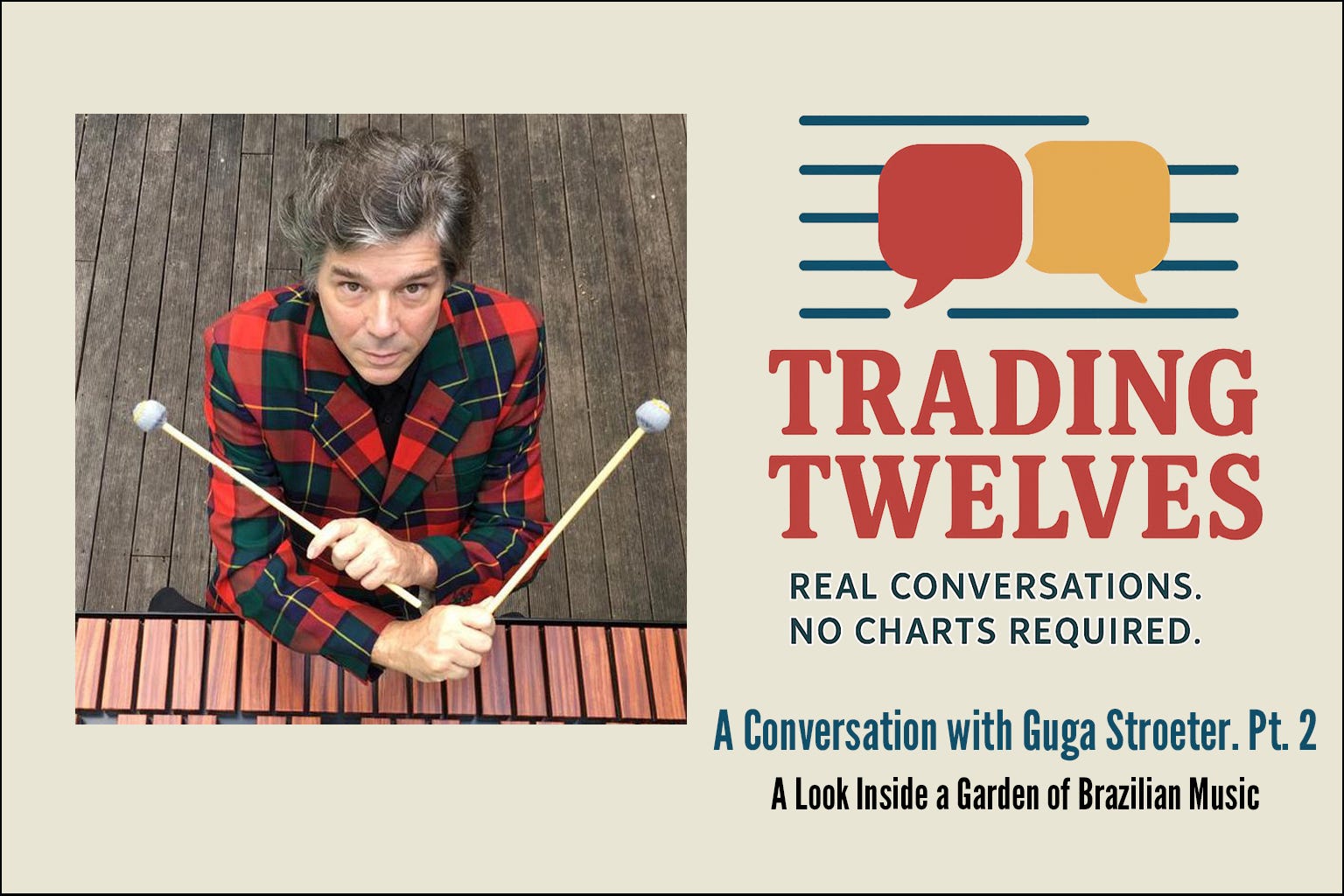
A Conversation with Guga Stroeter, Pt. 2
A Look Inside a Garden of Brazilian Music
In Part 1, Guga walked us through the garden of his home in São Paulo, where trees, bees, and even a spider named Adelaide coexist in a cultivated ecosystem not unlike the one he and Elisa Mori map in A Tree of Brazilian Music. We explored the roots of that tree, from indigenous and African traditions to the music of Portuguese colonial life, and the challenges of documenting a continental nation's worth of sound. Here, we pick up our conversation over the branches, from the cultural battles over electric guitars and outside influences, to the brotherhood between jazz and samba, to a moment when Wynton Marsalis sat in with a group of nervous young Brazilian musicians and called a blues.
Q: How have sentiments evolved around incorporating outside influences into Brazilian music? For example, the initial introduction of electronic instruments, such as electric guitar, caused a polemic within music circles.
Guga:
In Brazil, we’ve always, since the 17th century, had a conflict between the people who have defended the notion of a pure Brazilian culture and the people who have believed that Brazilian culture is made up of many different influences. In 1922 in São Paulo, we had a very important aesthetic movement, our modernist movement, that spread all over Brazil. The modernists wrote a manifesto called the Anthropophagic Manifesto, which argued that Brazilian culture was a cannibal culture that consumes foreign, as it happened literally in early periods of Brazil’s history to some of the colonizers. But metaphorically, it consumes foreign cultures and transforms them into a Brazilian style. This is something that has always happened.
For example, today, we have a very strong Brazilian hip-hop movement, but in the beginning, hip-hop was considered too “Yankee”. Electronic sounds and instruments were also considered “Yankee”, depending on the period and how nationalistic people were.
Brazil had a dictatorship from 1964 until 1985 that was sponsored by the CIA, by American politicians, because the American government was afraid of losing South America to the communist movement, like what happened in Cuba. During this time, many nationalistic musicians were very angry at rock and roll and the electric guitar. If you played the electric guitar, they would say you were imperialized or colonized. There were movements in the streets against the electric guitar, but they didn’t last very long. This anthropophagic cultural cannibalism incorporated the guitar and the electric instruments into a Brazilian musical expression.
Q: And what are some of the ways that jazz has influenced Brazilian music?
Guga:
Jazz has been in Brazil since the beginning of the 20th century, but it has had a different connotation. I’m not a radical nationalist, but musicians have always considered jazz to be a positive influence on Brazilian music. Yes, it came from a large country that was expanding, and spreading its culture, but jazz had in its roots, an expression of freedom. A possibility of having a personal and a collective expression of freedom.
Its influence made Brazilian musicians more free. They could improvise and they could write arrangements in different styles. Jazz was never criticized as “Yankee” or “imperialist”.
The exposure to jazz first came through movies, first with silent films and then through Hollywood. Later in the 40s and in the early 50s, swing became very popular amongst the Brazilian bourgeoisie. Swing orchestras and singers like Bing Crosby and Frank Sinatra.
The biggest influence of jazz music in Brazil happened during the 50s, when the young upper middle class boys from around 17 to 21 years old, who listened to samba, but also loved Stan Kenton and Chet Baker, made a fusion of cool jazz harmony, the West Coast style, with samba in a synthetic, minimalist aesthetics. This movement was called bossa nova. For us, bossa nova, is a kind of jazz-influenced samba. But I’ve heard people outside of Brazil say that bossa nova is a jazz style with a tropical accent.
After this, jazz became very important, especially to instrumentalists. We created many generations of Brazilian musicians making Brazilian jazz, but admiring Miles Davis and John Coltrane and in the 70s, jazz fusion. It’s not my favorite style, but it was important here.
We always considered Brazilian samba and jazz music as brothers because they both genres are evolutions of the syncopations that were brought to the Americas through the richness of African polyrhythms.
Q: In the epigraph of the book, you cite a quote from Mario de Andrade:
“And laughter struck the air, the shouting, the coco caught on in a flash, those people danced, stamped their feet in dance, joyfully, the chorus swelled in the enthusiasm, the stars twinkled almost sonorous, the warm air almost sensual, woven with deep scents. And it was utterly strange. Everyone sang, […] flirted, laughed, danced, the wonderful night, the abundant climes, […] vibrated an immense joy, a sonorous joy, yet within it there was something intensely sad.”
This speaks to an important aspect of Brazil, which prominently appears in samba, dealing with sad and sorrowful themes accompanied by happy and upbeat music. How would you compare this with a music like the blues, which deals with similar themes of life?
Guga:
I think these are two very, very powerful musics. I think the blues is one of the most amazing experiences that exists in the 20th century. It’s only 12 bars. It’s a very basic structure, but it’s changed the world.
I remember when Wynton Marsalis came here for our first jam. Surely the young Brazilian musicians were excited, but they were also very nervous to play in the presence of Wynton. They wanted to play tunes like “Giant Steps” and “Dona Lee”. And Wynton said, no, no, no. Then started a blues. With the blues you can start simply and then go into any kind of abstraction. You can go very far away from where you started. Blues has this power.
And then samba. Samba is made of an array of styles. There are maybe 40 or 50 different kinds of samba. The first samba was recorded in 1917 in Rio de Janeiro, which had the first radio stations in the country. Within a few years, music from Rio de Janeiro spread all over the country.
As a music, I think the blues is more clear in its emotional expression. It’s more sad. It’s melancholy. Samba on the surface is happy. It’s a sensual dance. But it was built in a very, very cruel historical context. Brazil was the last country to abolish enslavement. Throughout the history, there was a lot of repression and a lot of blood. Samba though it is a happy and sensual dance, carries a lot of sorrow within it. But both, samba and the blues are very powerful.
Q: What are some of the main differences between jazz, and jazz influenced styles such as bossa nova that might not be obvious to musicians not familiar with Brazilian music?
Guga:
Louis Armstrong once said “If you have to ask what jazz is, you'll never know”. Rather than being a thing, it’s a way you do the thing. When people speak about jazz here, American jazz, we imagine the triplet. The four against three. That characterizes the tension that makes the jazz swing. This is not common in Brazilian music. The other components of jazz though, like the concept of improvising and the concept of real-time, group communication like call and response, in an organic, live process. Through jazz, we learn here in Brazil, to improvise and open our ears to that experience.
The “blue note” is also a major contribution of jazz into many styles of Brazilian music. But you can still do a lot of Brazilian jazz without blue notes. You can play samba jazz, you can play baião jazz, you can play maracatu jazz. It is defined more by idea of the freedom than it is the style.
Q: If someone wanted to get into Brazilian music, where would you recommend that they begin?
Guga:
It depends on the taste of who is interested. But I think we can make some parallels between American music and Brazilian music. There are historical parallels between American and Brazilian history.
In the late 19th century, after slavery was abolished, and cities began to grow, there was music in Brazil that paralleled ragtime and stride piano. Here, there’s a clear influence of concert music. In the 20th century, this music was spread through new media like radio and records, similar to the development of jazz. This era from the beginning of the twentieth century to the end of the Second World War is considered the golden age of Brazilian music.
To make specific parallels, if you like Satchmo, listen to Pixinguinha. Pixinguinha was a great showroom musician.
If you like Gershwin, that is something between the concert music and the popular music. Here we have Villa-Lobos.
And if you like the sophistication of harmonies of Duke Ellington, we have Tom Jobim.
I think this is a good trio of reference to approach Brazilian music.
Q: What advice do you have for young musicians today?
Guga:
I think things radically changed with artificial intelligence. It’s like when a snake changes its skin, except we don’t know exactly what’s going to come out of it.
It’s good to choose an instrument and practice that instrument, to learn harmony and rhythm, but don’t skip this knowledge simply because an algorithm will do this for you through your prompts. It’s important have an instrumental experience: a voice that sings and an instrument that plays and a body that dances.
In these three things, we remain connected to the first human beings. We like music because our ancestors before us also loved music. You can look at this idea through Darwinist perspective, not just as natural selection of genes but also through behaviors and culture. We don’t make music or listen to music simply because it’s fun. We do so because without music probably we would be extinct.