
A Conversation with Wynton Marsalis: A Composer’s Retrospective — Black Codes (From the Underground): Part VI
Marsalis discussed his legacy, influence, and the making of Black Codes

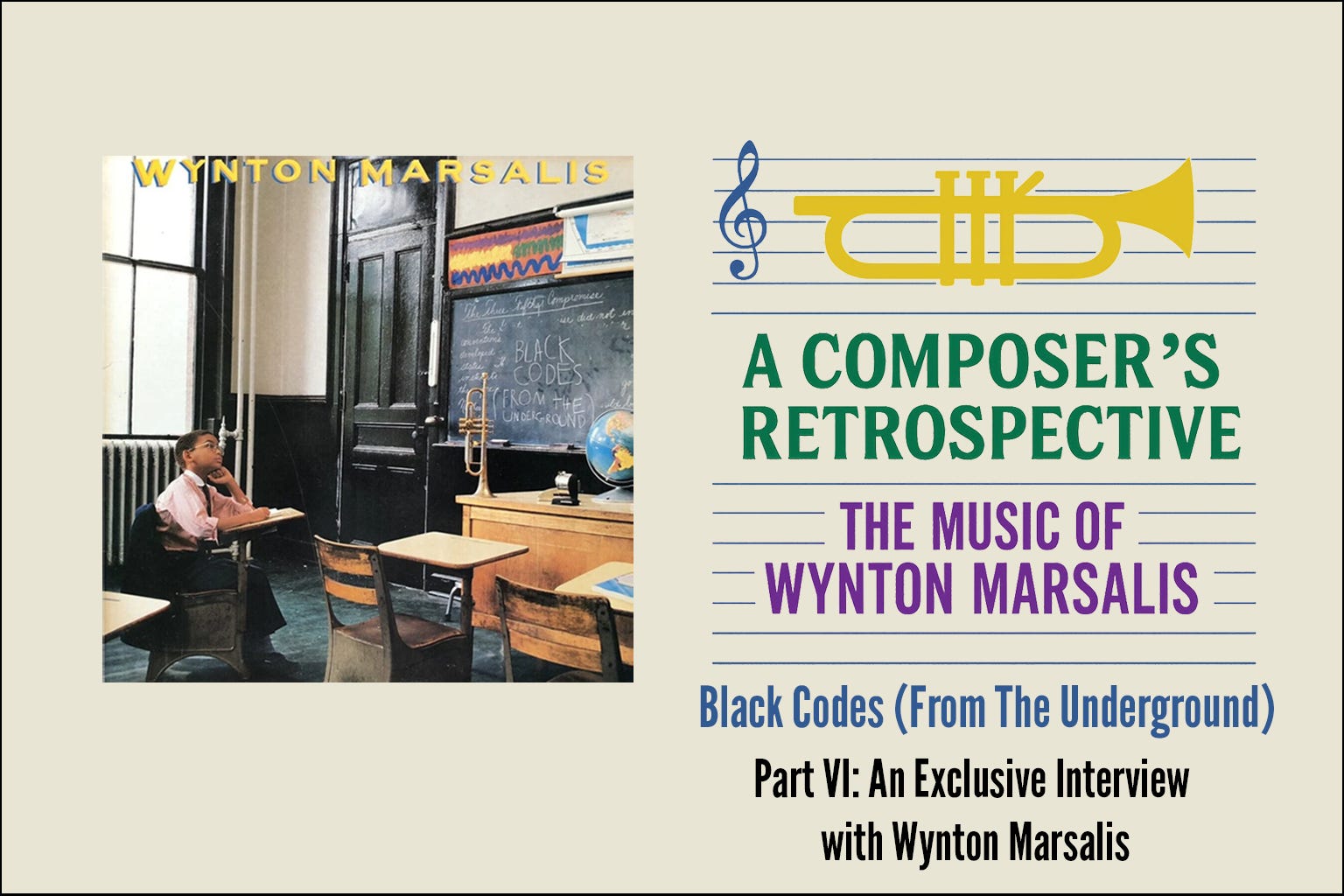
Q: Since this is a retrospective on Black Codes (from the Underground), I wanted to know where you thought Black Codes sat within your legacy compositionally and your playing.
Marsalis:
It’s hard for me to say what my legacy is, to be honest with you. I’m 64 now, and I did the record 41 or 42 years ago. I think I was 23 when we made that recording.
But a lot of the songs on Black Codes have similarities to the songs that my father played in the early 1960s on a record called The Monkey Puzzle. But I didn’t even notice the similarities to those songs until much later. When I was writing the songs on Black Codes, I wasn’t thinking about it.
But I guess those songs on The Monkey Puzzle was so ingrained in my consciousness, since they recorded that album, I think, in 1962, when I was one. But they played it a lot. The record was on, and I would see their gigs when I was a really small baby.
![Ellis Marsalis Quartet – Monkey Puzzle - Ellis Marsalis Quartet At The Music Haven – Vinyl (LP, Album), 1963 [r5755212] | Discogs](https://substackcdn.com/image/fetch/$s_!A71-!,f_auto,q_auto:good,fl_progressive:steep/https%3A%2F%2Fsubstack-post-media.s3.amazonaws.com%2Fpublic%2Fimages%2Ff7fc17bf-8bde-482e-a206-f5d928a2d680_600x599.jpeg "Ellis Marsalis Quartet – Monkey Puzzle - Ellis Marsalis Quartet At The Music Haven – Vinyl (LP, Album), 1963 [r5755212] | Discogs")
So there’s similarities in a lot of the songs, like the use of the 3/4 bar. Black Codes is based on the melody of James Black’s “Magnolia Triangle”. It’s like a kind of reorganization of that melody with the “Hey Pocky A-Way” bass line from the Meters. That’s from a different time.
And all those kinds of things that are in there resemble the music my daddy and them were playing.
Q: Yeah, it seems like at the time, from talking to some of the band members, reading a lot about reviews and things that came out around the time, it seems that there was a fixation on, or a lot of people pointed to the inspiration from Miles Davis and John Coltrane. Well, mainly Miles Davis and Wayne Shorter.
Marsalis:
Well, you know, of course, John Coltrane’s and Miles’ influence is in everything. I mean, how can it not be in something you do if you come after them?
I guess the type of solos I was trying to play from a thematic standpoint is related to the way Miles played, based on how Louis Armstrong played. Anybody who knows the history of music tries to play like him. Even at that time, I knew enough of Pops to try to play coherent solos.
A more abstract song like “Aural Oasis”, that is like a Wayne Shorter song with the use of minor 11 chords and that kind of sound. And something like
