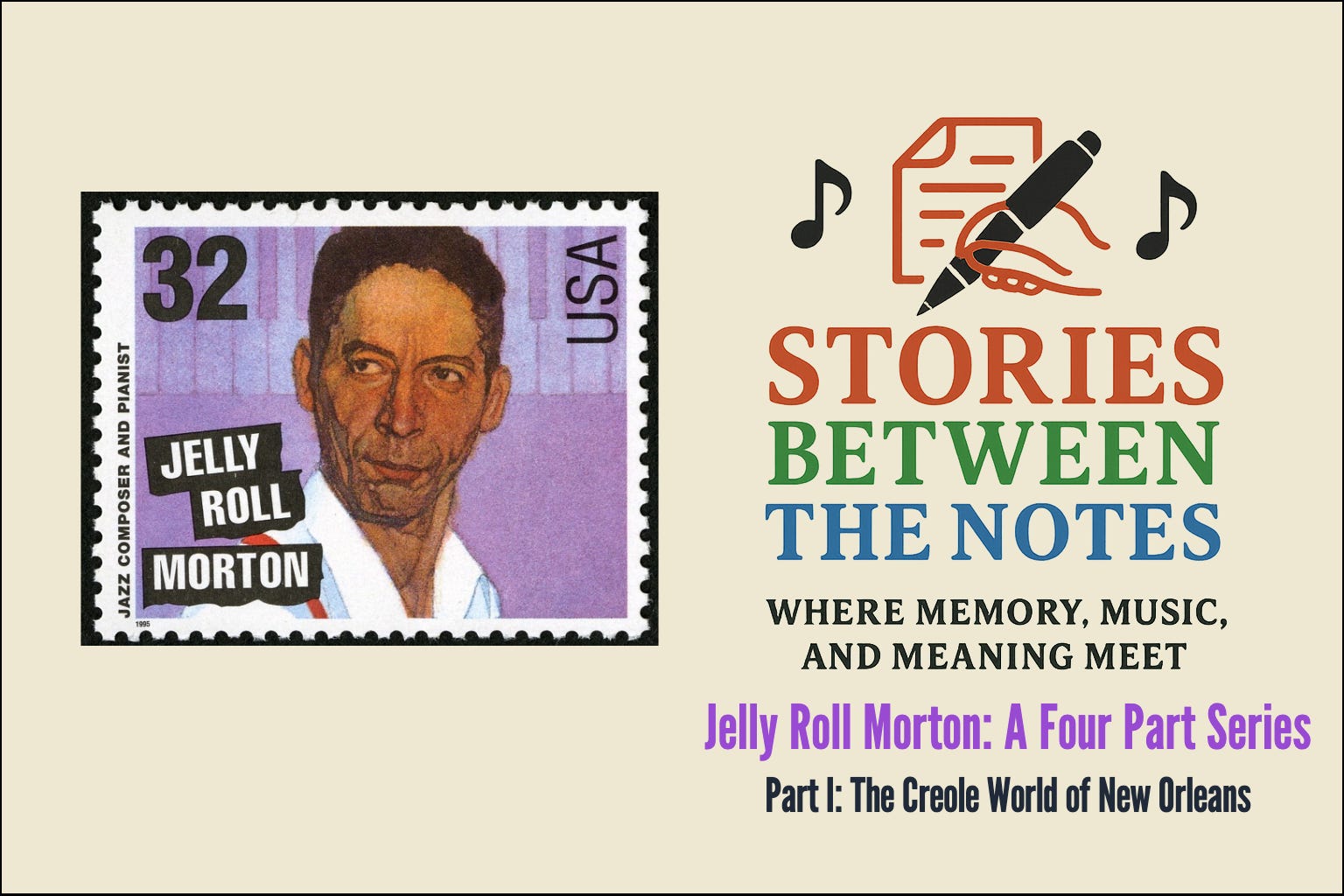
Jelly Roll Morton: A Four Part Series — The Creole World of New Orleans
The History Behind the Man Who Claimed to Invent Jazz
In the opening of Mister Jelly Roll, folklorist Alan Lomax frames Jelly Roll Morton as both a foundational figure in jazz history and one of its most persistently misunderstood. Central to his narrative was the legitimizing of Jelly Roll Morton’s claim to have invented jazz. This is a claim that is often repeated when addressing Morton as a figure, often in a way to deride the claim that any one person could have invented a music as far-reaching and important to the history of the nation’s culture. Despite the American love of the individualist hero, the singular genius in storytelling and historical narratives, it was always hard for people to take seriously this claim of Jelly Roll Morton.
Lomax provides the context necessary to understand what Morton was actually communicating through these seemingly boastful claims.
“When Jelly told his audience that he had invented jazz, he was speaking up for his hometown in New York’s Harlem, which so often has taken all the credit for black cultural innovations. Jelly had squelched Handy for asserting that jazz was born in Memphis. And here in Harlem, where the carriers of the great tradition were few, where big bands with horn sections were replacing the lacy counterpoint of New Orleans, he was sticking up for his hometown. He was grieved and shocked when he saw his musical acquaintances jumping on the bandwagon, which he and his hometown friends had started to roll, without learning to speak the language of jazz in classic New Orleans style.
Though it is widely understood that jazz comes from New Orleans, it is often misunderstood what it means for jazz to have come from New Orleans. It wasn’t a matter of a singular origin point of something that would spread nationwide, but rather the story of a city and the people of that city in all of the splendor and tragedy. Jazz for New Orleans is the pride of its people’s history.
Morton’s claim, then, was not simply personal mythology, but a defense of a musical world that included figures such as Buddy Bolden, whose legendary cornet playing helped define the earliest sounds of the city, King Oliver, who carried that tradition forward into the early recording era, and Sidney Bechet, whose virtuosity brought New Orleans style to international audiences.
From this perspective, one can begin to understand the frustration Morton must have felt upon arriving in New York, only to encounter a jazz culture increasingly indifferent, if not hostile, to the traditions from which he emerged. In a city that was rapidly becoming the commercial and cultural center of jazz, earlier New Orleans styles were often dismissed as outdated or “corny,” and Morton himself, never one to temper his self-mythologizing, was met with ridicule as much as recognition.
This tension is perhaps most visible in the remarks of Duke Ellington from a conversation Ellington had with Leonard Feather where he said of Morton:
“Jelly Roll was a writer. He had more published music than anybody else. Other than that, I don’t know anything about him as a performer, you know, he couldn’t play no piano…I heard him play piano but he was, he played piano like one of those high school teachers in Washington. Matter of fact, high school teachers played better jazz.
As Stanley Crouch observed in his essay, “Way Down Yonder in New Orleans” despite Ellington’s distaste, Ellington remained deeply shaped by Morton’s music. The foundations Morton had laid for works of Ellington such as Creole Rhapsody and Black, Brown, and Beige, both works written within Morton's lifetime after Morton's appearance in New York, are evident. In these works Crouch points out how Ellington furthered the identity of jazz, “pulling together concert sophistication and the omni-directional singing, dancing, and street vitality given special aesthetic power by the blues.” Even figures who rejected Morton were shaped by the tradition he represented.
But when Morton had arrived in New York in 1928, what he found was a similar music, which was indeed related to New Orleans, but was born of a different tradition and history. Lomax describes the roots of the music being played in Harlem at the time of Morton’s arrival:
“The roots of Harlem’s entertainment tradition were rather in the minstrel show, modernized for Broadway. I say this, not in criticism of the elegant artists of Harlem—Fats Waller, Rosamund Johnson, Cab Calloway, Duke Ellington, and all the great men of bop—but only to cavil at the inhospitable treatment that New York gave to the great music of New Orleans and its cantankerous proponent, Jelly Roll Morton.”
It may seem like a pedantic distinction, but the jazz music that grew out of Harlem stride grew out of a related but distinct tradition, shaped by different social and theatrical lineages. Both styles have partial roots of ragtime music, possibly one of the first commercial music craze of the United States, but the history of New Orleans and the influences that were allowed to coalesce, from the drumming traditions of Africa, the Afro-Caribbean, the popular music from across Europe, classical musical traditions instrumental and operatic, were all important elements unique to a city with a colonial history unlike any other in the United States.
Within this history carries the story of struggle and perseverance of the many groups of people that made up the city’s black population: enslaved from all across West Africa and the French and Spanish colonies in the Caribbean and later from other American state, free blacks who had purchased their freedom, free blacks who had immigrated from across the Caribbean and North America, and the colored Creole population, of which Jelly Roll Morton is possibly the most famous.
Jazz growing during the days of the failure of Reconstruction of Louisiana, for which was a project that Louisiana’s black population actively participated in and shaped, carried within it the resiliency and democratic aspirations of a people who were brutally repressed under the boot of a resurgent white supremacy. It is within this convergence of peoples, histories, and cultural forms that jazz emerges, not as the invention of an individual, but as a fundamentally collective and democratic expression.
Jelly Roll Morton carried with him this vibrant history and culture wherever he went. He was one of jazz’s earliest ambassadors who had a very clear idea of what jazz was and had an established narrative of its history. As Alan Lomax put it, Jelly Roll Morton saying he invented jazz was his way of proclaiming “Jazz is from my hometown. I was rocking the cradle of jazz before you guys were born.”
In this series on Jelly Roll Morton, I wanted to examine jazz as he understood, composed, and played it. This article, broken into two parts, examines the historical world that produced Jelly Roll Morton, centering the black and Creole communities of New Orleans, in order to understand jazz as the expression of a complex, deeply rooted social and political history. To understand what Morton believed he was defending, one must understand the social world that produced both him and the music he claimed.
The Louisiana Creoles
For many Americans outside of Louisiana, the existence of the Creoles complicates conventional American understandings regarding the categorization of race, ethnicity, and culture. We tend to throw all of these complex ways in which identity is formed into the essentialized category of race. This is further reduced to the binary of black and white. Though the country is defined by its diversity of cultures, ethnicities, and “mixed” peoples, this binary tends to flatten our understanding of ourselves.
“Creole” is a protean term existing somewhere between white and black. It appears differently to different people and can mean different things depending on the context. The word originally came from the Portuguese, crioulo, a word used for a slave raised in the owner’s house. The Harvard Encyclopedia of American Ethnic Groups defines Creole in Louisiana as the following:
“Louisianians of French and Spanish descent began referring to themselves as Creoles following the Louisiana Purchase (1803) in order to distinguish themselves from the Anglo-Americans who started to move into Louisiana at this time….In the United States, in the 20th century, Creole most often refers to the Louisiana Creoles of color. Ranging in appearance from mulattos to northern European whites, the Creoles of color constitute a Caribbean phenomenon in the United States. The product of miscegenation in a seigneurial society, they achieved elite status in Louisiana, and in the early 19th century some were slaveholders. Many, educated in France, were patrons of the opera and of literary societies.”
The term “Creole” is wrapped in the history of colonization and slavery and with Louisiana’s attempt to reconcile its history into clear categories. To understand what it means to be Creole in Louisiana, one must first understand what it meant to be black.
Unlike in the rest of the United States, in Louisiana, to define “Negro” or black was always a difficult task, subjected to differing legal and cultural norms, and expectations born from Louisiana’s complex history. New Orleans native Alice Moore Dunbar-Nelson in her essay “People of Color in Louisiana” wrote of this issue:
“The possible title of a discussion of the Negro in Louisiana presents difficulties, for there is no such word as Negro permissible in speaking of this State…By common consent, it came to mean in Louisiana, prior to 1865, slave, and after the war, those whose complexions were noticeably dark. The gens de couleur, colored people, were always a class apart, separated from and superior to the Negroes, ennobled were it only by one drop of white blood in their veins….To the whites, all Africans who were not of pure blood were gens de couleur. Among themselves, however, there were jealous and fiercely guarded distinctions: “griffes, briques, mulattoes, quadroons, octoroons, each term meaning one degree’s further transfiguration toward the Caucasian standard of physical perfection.”
The instability of these racial categories was not incidental, but the result of Louisiana’s colonial history under French and Spanish rule. The Spanish were the first to import slaves into the state. Louisiana as a territory began to import slaves from the Spanish West Indies, namely Cuba, Hispaniola, Puerto Rico, and Jamaica. The most predominant ethnic groups consisted of Congo, Bambara, Yaloff, and Mandingo slaves.
Originally brought in to Louisiana for the laborious task of working the land, the growth of the enslaved population, combined with widespread sexual relations, often coercive, between enslavers and the enslaved, produced an increasingly mixed population.
“The slave population began to lighten in color, and increase out of all proportion due to the importation and natural breeding among themselves. La Harpe comments in 1724 upon the astonishing diminution of the white population and the astounding increase of the colored population.”
Sensing the problematic growth of this population of “people of color”, Jean-Baptiste Le Moyne, Sieur de Bienville created the “Code Noir”, a 54-article set of regulations governing the status, treatment, and conduct of enslaved people in the colony of Louisiana. Though this legal code led to the social ostracization of the enslaved population, there were provision that would prove consequential for the development of the Louisiana creole.
While the Code Noir enforced racial hierarchy, it also created legal pathways that allowed a free population of mixed-race individuals to emerge and grow.
“The slaves had to be instructed in the Catholic religion. Slaves appointed by their master as tutors to their children were set free. Moreover, manumitted slaves enjoyed the same rights, privileges and immunities that were enjoyed by those born free.”
Thus a population of free “negroes” and “mullatos” began to grow, and over time took on the term “creole”. “Creole” as an identity has been difficult for people within the state to pin down. Louisiana, like many of its Caribbean cousins, was a racially fluid society, where race was more defined by perceptions than ethnicity or genetics. But over time, Creole began to be defined as “a native of the lower parishes of Louisiana, in whose veins some traces of Spanish, West Indian or French blood runs”.
Alice Moore Dunbar-Nelson so elegantly puts it: “The true Creole is like the famous gumbo of the state, a little bit of everything, making a whole, delightfully flavored, quite distinctive, and wholly unique.”
This population would go on to develop their own distinct cultural world in nineteenth-century New Orleans. It is within this world that new forms of music, performance, and social expression would begin to take shape.
The Rise in importance of the class of free blacks to Louisiana
An important decision, made out of necessity, that would prove important for the democratic aspirations of the black population of Louisiana, would be the state’s use of the enslaved in the defense of the colony. The first precedent was set by Governor Étienne de Perier whose major concern when he assumed power was the ongoing conflict with the Choctaw. Choctaw raids exposed the vulnerability of the colony and inspired fear across the populace.
Understanding that many of the Africans in the colony themselves were warriors, with the Bambaras being the most fierce, Governor Perier, organized a small militia of enslaved. Perier first targeted, a friendly tribe surrounding Louisiana, the Chouca and subjected them to a campaign of extinction as an intimidation tactic to the surrounding tribes. This also was a tactic in further isolating the enslaved African by creating a state of hostility between them and the indigenous tribes.
Perier’s precedent of arming the enslaved population, though intended to solve the issues facing the colony regarding the indigenous and the potential issue of them uniting with the enslaved against the colony, opened up the real possibility of the enslaved being able to fight for their freedom. From this military impression rose what Alice Moore Dunbar-Nelson described as an aristocracy of free blacks.
“Here is the very beginning of that aristocracy of freedom so fiercely and jealously guarded until this day, a free person of color being set as far above his slave fellows as the white man sets himself above the person of color. Three explanations for this aristocracy seem highly probable: Some slaves might have been freed by their masters because of valor on the battlefield, others by buying their freedom in terms of money, and not a few slave women by their owners because of their personal attractions. It makes little difference in this story which of the three or whether all of the three were contributors to the rise of this new class. It existed as early as 1724, twelve years after the first recorded slave importation.”
This population of free blacks with a military background led to these militias of the enslaved being commanded by free blacks. After the French ceded ownership to Spain in 1763 as a result of the Seven Year’s War, the the Spanish continued this reliance upon the militia of enslaved blacks commanded by free blacks.
During the early years of the US administration in Louisiana, the free black population, would also grow in importance to the commerce and wealth of Louisiana with the arrival of refugees from the island of Hispaniola, fleeing the violence of the Haitian Revolution and Caribbean theater of the Napoleonic Wars between France and Spain. These immigrants not only increased the population of free blacks, but also brought with the, the knowledge of sugar cane growth, and the production of molasses and rum. This convergence would lead to the growth of New Orleans as a major commercial hub.
When the United States took over administration of the colony, with the Louisiana Purchase of 1803, the US Governor William Claiborne faced the issue of how to handle its black population. Blacks had been central to the settling of the colony, its commerce, and its defense, giving them a central position in Louisiana as a whole. One couldn’t bring the heavy hand of racial separation as an easy solution to the issue of Louisiana’s diversity. The kind of diversity which was alien to American ideals governance. Governor Claiborne understood that he was effectively being tasked with integrating a foreign nation into the country. Dunbar-Nelson described the what the Americans encountered:
“Writers describing the New Orleans of this period agree in presenting a picture of a continental city, most picturesque, most un-American, and as varied in color as a street of Cairo. There they saw French, Spaniards, English, Bohemians, Negroes, mulattoes; varied clothes, picturesque white dresses of the fairer women, brilliant cottons of the darker ones. The streets, banquettes, we should say, were bright with color, the nights filled with song and laughter. Through the scene, the people of color add the spice of color; in the life, they add the zest of romance”
When the Napoleonic Wars finally came to the shores Louisiana, with the war of 1812 between the United States and the British Empire, the US administration followed the same strategy of defense as the Spanish and the French before them. The black population, free and enslaved were vital to the defense of New Orleans organized by Andrew Jackson, repelling the British invasion, in one of the few American victories within the conflict.
Following the War of 1812 the positions of free blacks and Creoles in Louisiana began to solidify and grow socially and economically. With this growth of this community, more free blacks from other regions of the United States began to immigrate to New Orleans, as the city became a “haven of refuge” from the norms of American racial segregation.
The work that defined this community of free blacks and colored Creoles was skilled labor in crafts and trade professions. Historically within Louisiana, many of the free blacks and colored Creoles worked the same jobs as slaves, and often alongside them. Between free blacks and slaves existed an exchange of expertise, especially from the slave population who brought specific expertise from Africa.
The most significant distinction between them, however, lay in legal and economic access. Like whites, free blacks and Creoles could own property, enter contracts, and participate in the open market reflecting an integration into the colonial system of Louisiana.
This integration extended to the institution of slavery itself. Free blacks and Creoles in New Orleans owned enslaved people at higher rates than their counterparts elsewhere in the United States. These relationships were varied. Some purchased enslaved family members to protect them from sale, while others participated in slavery as an economic enterprise.
This dual position, both marginalized by race and empowered within the local economy reveals the fundamentally contradictory nature of Creole society, a tension that would shape its cultural identity in the decades to follow.
Trades, skills and businesses were often passed down in families going back generations. Enslaved Africans and Creoles dating back to the 18th century under French rule were often selected and valued for specific skills, which were then transmitted across generations within Louisiana. In her essay “Visible Means of Support: Businesses, Professions, and Trades of Free People of Color”, New Orleans historian Mary Gehman writes:
“They had been selected in Africa for their knowledge of iron or woodworking, agriculture, food preparation, and nursing because they were better able to adapt to the tropical climate and primitive living conditions of the Louisiana swamps than were the skilled workers brought from France.”
Unlike slaves in other parts of the South, those in colonial Louisiana were encouraged to hire themselves out on municipal projects such as digging canals, building forts and levees, and constructing government buildings.
Slaves used this income to augment their already undocumented income from sales in order to buy their own freedom. As was a right given through the “Code Noir” a slave could petition for the right for their value to be assessed and this amounted to the sum they owed their master for their freedom.
At the highest echelons of society, there were influential families that worked as tailors, there were real estate moguls, and plantation owners. These wealthy free blacks and Creoles often rubbed shoulders with the wealthiest whites in Louisiana.
Other industries that had large concentrations of free blacks and Creoles were cigar makers, builders, architects, manufacturing, shoemaking, leather working. Mary Gehman gives a list of occupations held by free people of color from the 1850 New Orleans census.
The 1850 New Orleans census lists 1,792 free people of color in fifty-four different occupations, including 355 carpenters, 325 masons,156 cigar makers, 92 shoemakers, 61 clerks, 52 mechanics, 43 coopers, 41 barbers, 39 carmen, and 28 painters. Only 279, or about 9.9 percent, of free blacks were listed in the census as unskilled laborers. There were also blacksmiths, butchers, cooks, cabinetmakers, upholsterers, overseers, and stewards…Among the free women of color are listed 189 seamstresses, 21 dressmakers or modistes, and 10 hairdressers.
In 1850, New Orleans had the largest population of free people of color in the Deep South, around 9,905 individuals. This group that owned over $2 million in property, a figure that explains why the white planter class felt so economically threatened.
One can see these occupational traditions reflected in the people whom Jelly Roll Morton would grow up around near the end of the century decades later. Alan Lomax gives an extensive, but by no means exhaustive list of the trades these musicians worked. This is a small excerpt of that list:
“Papa Bechet, who played flute for fun, was a shoe-maker. Leonard Bechet, who played trombone in Silver Bell Band, is a maker of fine inlays…Papa deLisle Nelson, was an amateur accordianist, and a butcher. Louis deLisle (Big Eye) Nelson, maybe the first “hot” clarinet, worked as a butcher’s apprentice. Papa Dominguez, a fine classical bass, was a cigar-maker…Bab Frank, led the “first hot band” with his piccolo, ran restaurants….F. P. LaMenthe fooled with slidin’ trambone, but made money as contractor
The prevalence of these occupations and the economic diversity amongst the free people of color in New Orleans led to a cultural flourishing within these neighborhoods. Dunbar-Nelson cited the prominence of three major streets as a testament to this growth. This area is known today as the French Quarter, and is the center of New Orleans, culturally and economically.
Congo Square in the Creole quarter is where the slaves would congregate on Sundays as part of the provisions within “Code Noir”. This is where composers such as Louis Moreau Gottschalk would have first encountered African music and dances such as the bamboula. This was a spot of importance for the musical history of the city, preserving African musical traditions.
Camp Street, which would grow into one of the major streets of business in New Orleans got its name from the street being the location where free black migrants from the Haitian Revolution would live, as well as it being the location of the New Orleans slave market. The first gaslights were installed in the Camp Street Theater in 1833.
Julia Street was another street of commercial importance as it connected the city with Lake Pontchartrain and the greater trade within the Gulf of Mexico. Today the street is known for its number of art galleries.
French Opera House, which opened in 1858 was an important cultural space within the area where people of all different varieties of black and white would come to hear opera. It is where Jelly Roll Morton was first inspired to play the piano.
White backlash against the place of free blacks in New Orleans
With the growing economic importance of blacks, free and enslaved, and Creoles in New Orleans, the persistent issue of how to deal with the reality of the centrality of blacks to Louisiana. This growth was met with a reactionary backlash. The rising colored Creole aristocracy was seen as a threat by the class of white plantation owners in the state, especially with their close contact with the enslaved population. A flourishing black section of the city was not just a threat to the profitability of slavery, but to the institution as a whole. They feared the democratic ideals of freedom and meritocracy being engendered in these communities would inevitably lead to these ideas taking hold amongst the enslaved.
Following the 1811 German Coast Uprising, the largest slave rebellion in US history, the white ruling class of Louisiana sought to first diminish the influence free blacks and Creoles held over slaves and eventually economically isolate them.
Contact between free blacks and slaves was banned along with the migration of free blacks into Louisiana. The old codes of treatment guaranteed by the original “Code Noir” were revised as slavery in Louisiana transformed into an even more cruel institution with the intent of total subjugation of a large population of blacks, enslaved and free within Louisiana.
Despite this campaign, the population of free blacks and Creoles, persisted in growing in wealth and education. With their status being threatened these became a point of pride within the community. This is something Jelly Roll Morton would hold onto a century later when describing his family history to Alan Lomax.
My great-grandfather’s name was Emile Pechet—he was considered one of the largest jewelers in the South. My great-grandmother was Mimi Pechet—she traveled quite extensively and died when I was grown, at around one hundred years old. As soon as I can remember those folks, they was never able to speak a word in American or English. My grandmother, her name was Laura. She married a French settler in New Orleans by the name of Henri Monette—a wholesaler of fine liquors and cordials—that was my grandfather. And neither one of them spoke American or English.
When describing his family notice how he held on to status symbols in their trade, and the language they spoke. They were “Frenchmen” a he would refer to them, who did not speak “American” or “English”. He felt the need to set himself and his people apart from the usual American paradigm. Morton was speaking from an era where the position and prestige of Creoles had been diminished, and this memory of privilege was what he had left to hold on to.
The next part of this article will pick up the narrative with the Civil War, which would be the turning point in the story of free blacks and Creoles that would lead to the heights of their societal aspirations, helping shape the Reconstruction effort after the war, and the lowest point, when Reconstruction would fail, and the decades long campaign to ostracize the free black and Creole community would experience a powerful resurgence. It is from the collapse of this world, from its aspirations and its repression, that the music of jazz would emerge.


