
Jelly Roll Morton: A Four Part Series — The Musical Language of New Orleans
Part III: How Jelly Roll Morton Defined Jazz

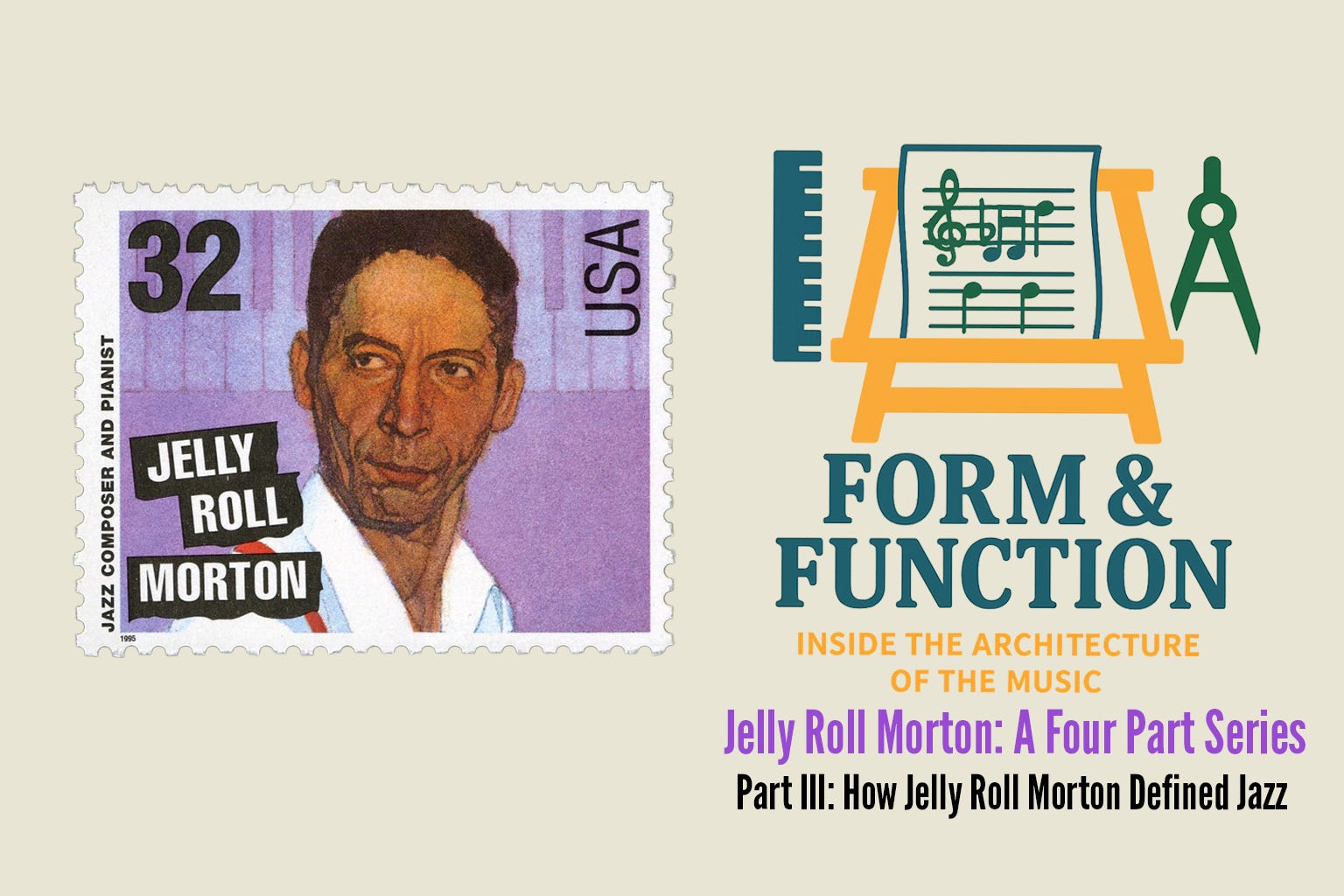
When Jelly Roll Morton arrived in Washington D.C. in 1935, his fortunes had declined considerably. After years of frustration with the New York entertainment industry and the changing direction of popular jazz, he was still undeterred in trying to find a receptive audience to his music and his message.
Just a year after arriving in Washington, Morton walked straight into the radio station WOL and requested an audition. After hearing him play, the station immediately offered him a nightly slot. As the Washington Daily News recounted:
“Friday afternoon he walked into WOL and asked for an audition. He gave no name. Just asked for a piano. He got it. A few bars, and WOL knew he was someone. His name was asked and given…So now, if you want to know where your present “swing” came from, you can hear “Jellyroll” regularly. He goes on tonight at 8:30 and will be heard every night this week at times governed by convention broadcasts. Next week he starts a series, “The History of Jazz”. It should be good listening.”
The significance of Morton’s time in Washington goes beyond notions of a forgotten musician of a bygone era seeking his just recognition. Morton understood himself as a historical witness to the emergence of jazz in New Orleans and increasingly saw it as his responsibility to explain where the music came from, how it functioned, and what distinguished it from the broader commercial world of swing orchestras and dance bands that were categorized under the label “jazz.”
By the time Alan Lomax encountered Morton in Washington and invited him to record at the Library of Congress in 1938, Morton had already begun publicly historicizing jazz through radio lectures and musical demonstrations. Morton arrived at the Library of Congress with the same theatrical bravado that had defined his public persona for decades. Elegantly dressed, he reportedly introduced himself to Lomax with the line:
“I’m Jelly Roll Morton, I’m the inventor of jazz, and they’re stealing my music.”
In another context, the claim might have sounded absurd. But like the people at the WOL radio station, Lomax knew there was something more to Morton, and throughout the weekly recording sessions, Lomax gradually came to understand the importance of what he was documenting.
In the Library of Congress recordings, Morton lays out a detailed conception of jazz involving rhythm, ensemble interplay, riffs, ornamentation, improvisation, and performance practice. In many ways, Morton was confronting a problem that still remains unresolved today: what exactly is jazz?
This article examines Morton’s own explanation of jazz and the musical logic underlying it, in order to better understand how one of the music’s earliest practitioners understood the language of jazz.
Jazz as a Language
As an analytical lens to analyze Jelly Roll Morton’s definition of jazz, I will utilize some ideas from music theorist Robert Gjerdingen from his book Music in the Gallant Style. Gjerdingen begins his book with an important idea for understanding music from different eras. Just as social cues and conventions change over time in a specific society, the same idea applies to musical language. One can learn the music of a particular era, but there are elements to how the music was interpreted, performed and improvised which were particular to this time period.
Gjerdingen uses the commedia dell’arte tradition as a metaphor. There were stock speeches, phrases, and gestures that went into acting, so that an actor would understand how to play the myriad of different characters. These plays were written based on an overall skeleton of scenes, where a specific beat will occur similar to how we would understand a lead sheet in music today.
Gjerdingen argued that music in the 18th century and into the 19th century in European classical music, also operated on this kind of system, where the bits and pieces of the musical language, such as melodies, ornaments, cadences, bass progressions, and stock harmonic sequences were internalized. This gave musicians a common language in which they could improvise full pieces together.
Gjerdingen uses the term “schema” to describe the stock musical figures and conventions internalized by musicians through repetition and practice. These schemata formed a shared musical vocabulary, allowing performers to recognize patterns, anticipate musical movement, and improvise within a common style.
Understanding the context of how the musical language was deployed was especially important to New Orleans music because of its use of collective improvisation. Like the commedia dell’arte, which was made up of stock characters, who had particular mannerisms, phrases, and speeches associated with them, the instruments in a Hot Five or Hot Seven New Orleans ensemble had similar roles within the collective improvisation. The trumpet, being the loudest lead instrument, took on the main melody with strength, vigor and finesse, while the trombone took on outlining and emphasizing the bass notes in a song. The clarinet provided counterpoint to the trumpet line, nuance to the harmonies the trombone was emphasizing, and provided texture to the song, filling in the space between the bass and lead instruments. Within these roles, there were stock phrases, licks, cadential phrases, and melodic figures particular to each instrument that would have been internalized by these musicians. They each understood their role in the music, and how that role shifted depending on the style of the song.
One can understand the frustration Jelly Roll Morton must have felt when encountering the jazz music being played in New York, where this musical etiquette, in the application of the musical language, as he knew it in New Orleans, was not being respected. When Jelly Roll Morton and other New Orleans jazz musicians complained about aspects such as how loud people played and the harmonic and melodic abstraction of jazz musicians, it's not simply older musicians complaining about the innovations of younger musicians. The very musical language they dedicated their life to, and the respective schemata that make up that language were being disregarded yet the name of the music remained the same. In this article, I will utilize this idea of “schema” from Gjerdingen to examine Jelly Roll Morton’s own definition of jazz music to try and illuminate some elements that Morton described that were common to this language.
The Rhythm of Jazz
When describing to Alan Lomax how he defined jazz, Jelly Roll Morton first makes the distinction between jazz and ragtime.
“All these people played ragtime in a hot style, but man, you can play hot all you want to, and you still won’t be playing jazz. Hot means something spicy. Ragtime is a certain type of syncopation and only certain tunes can be played in that idea. But jazz is a style that can be applied to any type of tune. I started using the word in 1902 to show people the difference between jazz and ragtime.”
For Morton, this was important. It’s not as much a distinction in the musical language, but rather in the feel and rhythm of the music. Ragtime, being a music derived from 2/4 and cut time marches, is mostly felt in two—oom-pah. Within this feeling there are syncopations usually in the melodic lines.
The music of New Orleans was divided into four beats instead of two. You can hear the difference in this feeling in Morton’s stomping foot that often accompanies his playing. Instead of an ebb and flow of “oom-pah, oom-pah” there is a constant “pah pah pah pah”. This feeling is crossed with what Morton calls “the spanish tinge”. The “spanish tinge” was an important element of bass rhythms in New Orleans and was important for as Morton says giving “a great background. It was the grounding element to the constant “pah pah pah pah” rhythm of the music.
The name “spanish tinge” is a broad allusion to its Afro Caribbean origins and is a product of the cultural melding between New Orleans and its Caribbean and Latin American neighbors as well as the history of Spanish colonization of Louisiana in the 18th century.
The rhythm of the “spanish tinge” enters New Orleans through several points in history. The first is the Afro-Caribbean influence in the music of Louis Moreau Gottschalk. This influence can be seen in compositions such as Souvenir de Porto Rico, and Danza, pieces which he composed during his travels throughout the Antilles islands, most famously Cuba, Hispaniola, and Puerto Rico.
The second point of entry comes from the popularity of the Cuban dance musical form the danzón. In their book Danzón: Circum-Caribbean Dialogues in Music and Dance ethnomusicologist Robin Moore and cultural theorist in sound and music of Latin America Alejandro L. Madrid, they point to the influence of danzón music performed by ensembles called orquestra típicas, which was “one of most influential forms of Latin American dance music, with enthusiasts in Costa Rica, Colombia, the Dominican Republic, Guatemala, New Orleans, Puerto Rico, and elsewhere.” These ensembles consisted of instruments such as violins, bass, clarinet, trombone and cornet, alongside percussion instruments such as timbales, the güiro, which featured a prominent cinquillo rhythm. Though as the music developed in Cuba into the 20th century, smaller ensembles began to become favored, larger ensembles of brass and woodwinds called danzoneras, were favored in Mexico.
It was these ensembles from Mexico which would be particularly popular in New Orleans. During the World’s Industrial and Cotton Centennial Exposition in 1884 on the site of modern day Audubon Park, the 8th Cavalry Mexican Military Band elicited an ecstatic reception for the six month run of the exposition. The band would return to New Orleans several times over the next two decades. The band was so popular that compositions performed by the band such as “Lazos de Amor” were featured in the catalogues of local sheet music publishers in New Orleans during this time.
Danzón repertoire, like their American brass band counterparts, consisted of marches, popular dance forms, and popular music of the time. The performance practices also share a similarity with that of early jazz as well featuring improvisation and improvisational ornamentations of melodies. As Moore and Madrid write:
Danzones have almost always been composed and notated by trained musicians, but often allow performers to interpret the score with a certain degree of melodic and rhythmic improvisation more characteristic of traditional/folkloric repertoire. The pieces feature European harmonies, yet both melodic lines and percussion patterns incorporate rhythms characteristic of West African traditions, as mentioned.
This can be heard in an early recording made by Pablo Valenzuela and his orchestra.
A third point of influence comes from what people in New Orleans referred to as the “Spanish” population of the city, which largely consisted of people from Iberia, and across Latin American and the Caribbean, and the Philippines. Many of the Creoles of New Orleans, white and black, came from a mixed Hispanic and French background. The hispanic part of the identity over time got subsumed in the broader term "Creole", especially amongst white creoles who sought to distinguish themselves from Americans during the early part of the American administration of Louisiana. Among some of the early New Orleans jazz musicians of Hispanic origin were musicians such as trombonist Edward “Kid” Ory, tubist Martin Abraham also known as “Chink” Martin. It is worth noting that both of these musicians played bass instruments. Their contributions were formative to how the bass was handled in New Orleans jazz.
The way that the “spanish tinge” manifests in the music of Jelly Roll Morton is through the habanera, tresillo and cinquillo rhythms. In his explanation of the "spanish tinge," Jelly Roll Morton plays his first composition, “New Orleans Blues” which goes back and forth between a tresillo and habanera rhythmic accompaniment.
This kind of accompaniment was an important part of how Jelly Roll Morton played the blues. In his performances of common blues ballads, such as “The Murder Ballad” he utilizes this combination of tresillo and habanera rhythms in the accompaniment. In this context, New Orleans Blues can be seen as a codified version of one of the ways Jelly Roll Morton played the blues.
Songs such as "The Crave", "Creepy Feeling," are more direct allusions to the Latino origins of the “spanish tinge”. They’re more compositions in the model of songs like “La Paloma” , than in a blues style with “spanish” rhythms. “Tia Juana” is another song in this model with overt references to Mexican music in the ringing thirds first section of the melody. It is worth noting that this song was published 2 years after Morton’s frequent visits to Tijuana during his stay in Los Angeles between 1917 and 1923, where he would play piano at a black American owned bar in Tijuana called the Kansas City Bar, for which he named his song “Kansas City Stomp”.
The “spanish tinge” is still a core rhythmic element of New Orleans jazz to this day, most prominently found in the tresillo patterns of bass drum rhythms in second lines.
Jazz as Vocabulary
In Morton’s definition of jazz, he gives a central importance to what he calls “riffs”. If jazz, for Morton, is a musical language, then the riff is one of its primary units of meaning.
“Always have a melody going some kind of way against a background of perfect harmony with plenty of riffs—meaning figures. A riff is something that gives an orchestra a great background and is the main idea in playing jazz. No jazz piano player can really play good jazz unless they try to give an imitation of a band, that is, by providing a basis of riffs.”
From Morton’s description of a riff, he’s not simply referring to a “riff” or “lick” as we understand it to be, which is a prepackaged musical idea utilized in a style. For Morton, riffs referred to the particular use of melodic figures in New Orleans collective improvisation. Riffs were used for their distinctive melodic quality and how easily they could be used over harmonies without clashing with other lines, or drawing unwarranted attention.
The musical language of early New Orleans jazz emerged from the interaction of European, African, and Caribbean traditions within a shared social and cultural environment. Musically, this meant that many of the figures and ornaments, common in 19th century European, American, Caribbean and Latin American music, across opera, salon repertoire, brass bands, and popular dance forms, were already part of the sonic world these musicians inhabited.
In 19th century New Orleans, this language was transmitted through the city’s musical institutions of theaters, the opera house, brass bands, and ballrooms, as well as through pedagogical traditions, connected to France, and rooted in the Creole communities. Much of this repertoire was itself shaped by Italianate pedagogy, which shaped much of Europe’s wider pedagogical traditions.
As a result, the materials that appear in Jelly Roll Morton’s playing are best understood not as direct borrowings, but as absorbed elements of a broader musical language, recontextualized within the framework of New Orleans jazz, particularly through its encounter with the blues inflected, percussive traditions of the city’s uptown black American community.
One place where the use of riffs was readily apparent was in cadences, which close musical phrases. Cadences, short harmonic progressions that signal the close of a phrase, function as punctuation, such as semicolons or periods. In classical music, they generally have specific voice leading implications which shape how melodic phrases end during the cadence.
In the context of the collective improvisation of New Orleans jazz, using specific riffs for cadences would be useful as a point of coalescence for all of the different instruments, and would reinforce the voice leading and counterpoint specific to the roles each instrument plays. They’re most often found to this day at the end of songs, punctuated by the hi-hat hit.
The cadential phrases are ubiquitous in Morton’s piano playing. These two examples are from “King Porter Stomp”, while this example is from “Freakish”. They’re also heard in his hot five ensembles as well, such as this example from his rendition of the W.C. Handy tune “Beale Street Blues”. This following excerpt of “Dippermouth Blues” from King Oliver’s Creole Band, is an example of its wider use in New Orleans as a whole during this period.
One of the types of riffs that distinguishes Jelly Roll Morton’s writing and piano playing from other jazz pianists of his era was his use of bass riffs. Morton was adamant that bass riffs were an integral part of piano playing stating to Lomax, “No jazz piano player can really play good jazz unless they try to give an imitation of a band, that is, by providing a basis of riffs.” Lomax attributes Morton's love of bass lines in his playing and composition to the influence of Morton’s father Ed La Menthe, who was a trombonist.
“This was a real discovery. Jelly Roll had mentioned playing trombone occasionally but the influence of his father ran deeper. Obsessively, in almost every line of his compositions, Jelly Roll wrote bass figures in tailgate style and sonorous, bursting melodies; trombone phrasing is the Jelly Roll trademark...”
The bass riffs added a layer of contrapuntal complexity to Morton’s playing and composition. There are even imitative passages within his improvisation giving his playing this kind of jazzy baroque quality. In his introduction to Mister Jelly Roll, Lomax gives Morton the epithet of the “American Vivaldi”, and rightfully so.
What the bass riff also gave was the impression of an entire band at the piano. Morton found this imitation so necessary that he repeats it in his explanation of the elements that make up jazz. For him it was a crucial part of piano playing. This way of approaching the piano may come across as somewhat foreign or even archaic to modern jazz piano playing, but in the 19th and early 20th century, the piano often had the role of filling in for bands and orchestras, whether it be at social events such as dances and balls, or in the pit of a theater, like the Lambert brothers Lucien and Sidney played when they were children. It would make sense that Jelly Roll Morton wouldn’t have wanted to lose all of the nuances and sophistication of hot ensemble playing in New Orleans while performing this music at the piano.
In his ensemble compositions, Morton would include these bass riffs in the trombone and tuba. “Wolverine Blues” has his most common riffs in the bass accompaniment to the melody, while “New Orleans Bump” features an opening bass riff and very active bass line in the tuba. The trombone line features Morton’s bass riffs in his arrangement of King Oliver’s song "Doctor Jazz."
Many of the musical figures Morton deploys as riffs make use of ornaments, such as grace notes, trills, mordents, tremolos, and turns. These ornaments form part of the schema of Jelly Roll Morton’s music.
One of the ways Morton used grace notes comes from blues playing, where he shades a blue note into a major third, as he does in the melody of New Orleans Blues. Morton really hammers this note accenting the dissonance.
The three-note grace note figure in the melody of Black Bottom Stomp does the opposite. It accentuates the major quality of the major third in the first half of the melody, which is in the key of B flat major. This contrasts with the second half of melody and the solo section in G minor.
Morton utilizes this three-note grace note figure within his improvisation. It can be heard in his solo in Black Bottom Stomp, but can also be heard in the melodies of songs such as King Porter Stomp.
Trills were also common ornaments. The transition melody in “The Pearls” features a prominent and tasteful use of a trill while the melody of the second section of “The Crave” features a tremolo utilized in a similar manner.
Morton’s use of turns in his melodies and improvisation is especially evocative of 19th century music. Turns were common ornaments in 18th and 19th century melodies but throughout the 19th century, they evolved into a cliché akin to something today in jazz as the infamously clichéd “lick”. Turns were used for their sentimental qualities.
In Morton’s music they take on an ornamental role but also allude to their sentimentality rhetorically. This improvised line from “The Crave” is made up of ornamental turns. This same riff is also featured in “Creepy Feeling”. The subsequent section of “The Crave”, is filled with affective, sentimental uses of turns.
Another common melodic figure of the 19th century Morton utilized, was the “yearning” motif, a melodic figure which appears widely in 19th-century operatic repertoire, but was a central motif in Richard Wagner’s opera Tristan und Isolde. While associated with Wagner, such figures were part of a broader Italianate melodic vocabulary that circulated widely in the 19th century.
To give an example from a New Orleans composer, this motif can be heard in the waltz L’Americaine, Grande Valse Brilliante by Charles Lucien Lambert.
This motif appears in Jelly Roll’s music, but divorced from its bel canto associations, generally used as a riff fragment rather than a melodic moment or focus. It can be heard clearly in the break in the melody of the Pearls, opening melodic figure of King Porter Stomp, and in a cadential phrase in “The Crave”. The use of this figure gives the melodic passages a more “genteel” quality and may have been allusions to this kind of music of 19th century New Orleans.
There’s a particular riff that Jelly Roll Morton deployed frequently throughout his piano playing which is made of a combination of this “yearning” motif and another common melodic fragment utilized in waltzes. These two examples come from the waltzes of Johann Strauss II. The Morton riff is used in melodies he composed such as “Shreveport Stomp” and “Freakish” as well as in his improvised solos.
The full extent of Morton’s utilization of riffs and his command of this musical language can be seen in this solo passage of “Winding Boy Blues”. Notice the long flowing melodic lines, and how fluidly he connects these riffs, ornaments, and flourishes in the context of the blues.
During Morton’s travels across the country, one of his central criticisms of jazz piano players he encountered was the lack of riffs, or their improper application. Morton would praise early swing pianist Bob Zurke for his tasteful use of riffs. This highlights the importance Morton gave to riffs as a foundational feature of the musical language of jazz.
“I’ve seen riffs blundered up so many times it has given me heart failure, because most of these modern guys don’t regard the harmony or the rules of the system of music at all. They just play anything, their main idea being to keep the bass going. They think by keeping the bass going and getting a set rhythm, they are doing the right thing, which is wrong. Of all the pianists today, I know of only one that has a tendency to be on the right track and that’s Bob Zurke of the Bob Crosby Band. Far as the rest of them, all I can see is ragtime pianists in a very fine form.”
Observe the way Zurke in the song “It’s a Hap Hap Happy Day” phrases his melodic lines and makes use of the riffs and cadential phrases common in Jelly Roll Morton’s music. In this song one can hear the overlap between early swing and New Orleans jazz.
Jazz as Performance Practice
Alongside the musical language of jazz, there is an element of the music that Jelly Roll Morton called “novelty”. He gives a few examples of novelties which became a central part of how jazz was performed.
Most people don’t understand the novelty side of jazz. Vibrato—which is all right for one instrument but the worst thing that ever happened when a whole bunch of instruments use it—was nothing at the beginning but an imitation of a jackass hollering. There were many other imitations of animal sounds we used—such as the wah-wahs on trumpets and trombones. Mutes came in with King Oliver, who first just stuck bottles into his trumpet so he could play softer, but then began to use all sorts of mutes to give his instrument a different flavor.
Novelty can be best understood as showmanship. Jazz was about entertaining and putting on a show for the audience. It involved all kinds of extra-musical elements such as dance, in which the music was designed to respond to. Just as riffs, cadences, and ornaments formed part of the shared musical language of jazz, breaks, growls, mutes, sound effects, and dramatic contrasts formed part of its performative vocabulary.
One important novel addition the early jazz musicians added to their music was the “break”. Breaks are a part of jazz to this day and were an integral part of swing band performances. They’re the moments where the music comes to a sudden halt and a soloist is allowed to shine for just a split second. Morton’s use of breaks were not limited to ensemble performance though. He also wrote them into his piano music. A good example of a break written within the melody of a song is the main melody of “The Pearls” as referenced earlier.
Other examples of novelty within Morton’s music are his use of theatrical openings and sound effects. The introductions to songs such as “Steamboat Stomp” and “Dead Man Blues” are examples of this theatricality to the music, establishing a dramatic atmosphere before the main ensemble enters. Musical sound effects and extended techniques are also used within the performance such as the buzzing cymbal sounds in “Jungle Blues”, the growled clarinet solo in “New Orleans Bump”. These effects combined with multi-part forms of songs with interludes, dynamic range, and varied solos over this form including, trading solos, give these jazz songs a feeling of spontaneity and vitality to them, transforming performance into an experience.
Seen in this light, novelty was not separate from the musical language of jazz but part of its larger expressive language. These performance conventions formed another layer of the shared vocabulary that musicians internalized and audiences came to expect. Morton’s conception of jazz went beyond melodic figures, rhythm and improvisation into matters of texture, pacing, timbre, dramatic tension, and elicited audience responses.
Though Morton often criticized the direction jazz had taken elsewhere in the country, many of the elements he identified remained central to later jazz orchestration and performance. Duke Ellington’s music in particular demonstrates how these earlier New Orleans performance practices could be expanded into large-scale composition without losing their expressive foundations. The haunting vibrato of Ben Webster and Johnny Hodges, the dramatic contrasts in dynamics and texture, the use of growls, mutes, and orchestral color, and the multi-part structures of suites such as Black, Brown and Beige, Such Sweet Thunder, or The Queen’s Suite all develop principles already present in Morton’s conception of jazz.
Thinking back to Ellington’s comments on Morton, one senses that beneath Ellington’s occasional dismissiveness was a recognition of Morton’s importance as a composer and arranger. Ellington did not abandon the language Morton described, but rather he expanded its possibilities. The schemata of early New Orleans jazz, the rhythmic feel, riffs, breaks, ornamental figures, ensemble interplay, and performative conventions Morton spent his life describing, became the foundation upon which later composers built increasingly ambitious forms of jazz expression.
Below is the first movement of Ellington’s Black, Brown and Beige. With Morton’s definition of jazz in mind, observe how Ellington builds upon these foundations while developing a unique compositional voice of his own.
James Dapogny emphasized how Morton wrote with variety in mind. This essay elaborated on the depth of that musical variety. Thanks!
Regarding the harmony in Black Bottom Stomp please see Gunther Schuller’s Early Jazz where Schuller observes the tension created by leaving it unresolved for long stretches adds drama (that’s a paraphrase, there’s more specific discussion worth sighting I just don’t have it in front of me at the moment).
Thanks Wynton! If only there were recordings of WOL!