
Jelly Roll Morton: A Four Part Series — An Orchestra at the Piano
A Conversation with Aaron Diehl on the Challenge and Genius of Jelly Roll Morton

As a piano player, Jelly Roll Morton was a composer whose music I had engaged with from a young age. But learning his music always presented a problem for me. Despite how straightforward his songs seemed, from listening to his recordings, and interpretations done by other musicians such as Marcus Roberts, and Wynton Marsalis, when I sat down with the book of transcriptions collected by James Dapogny, the music was more elusive that it appeared. Unlike the ease of learning Scott Joplin, or a piece of classical music, whose notes on the page were fixed, Jelly Roll Morton’s music existed somewhere between a score and improvisation, and it wasn’t always clear which parts were which.
Morton developed a highly idiosyncratic approach to the piano. Some of his pianisms appear alien, especially when read on a page, with an idiosyncrasy akin to Robert Schumann where you would encounter figures entirely unique to him. To learn his music was to step into his shoes as a piano player and inhabit his pianistic world.
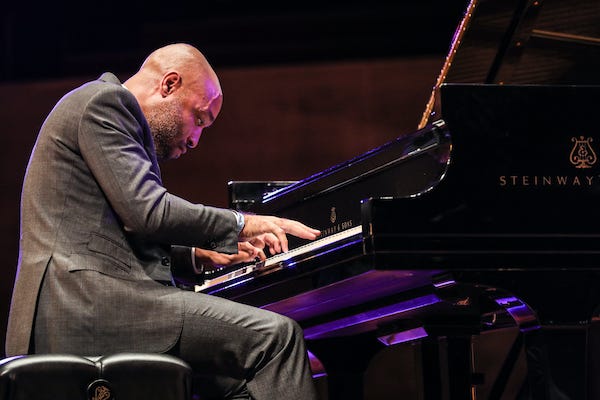
When I spoke to Aaron Diehl about Morton’s playing, I was surprised by how closely his experience mirrored my own. Diehl described Morton’s style not simply as jazz piano, but as “a very orchestral form of playing,” one in which “every element of the orchestration” could be heard within the keyboard texture itself. Even for a pianist of Diehl’s caliber, Morton’s music presented unique challenges. “I think Jelly Roll was probably one of the most difficult in terms of balancing many different elements, both rhythmic and melodically.”
One of the first things that becomes clear about Morton’s playing, as Diehl noted, is that it is orchestral in nature. His playing gave the illusion of the collective improvisation of New Orleans jazz bands and voice leading is key to this illusion. As Diehl pointed out, “ It’s not as really straightforward between the right hand and the left hand. They really work in tandem with each other and then it has to be very specific because otherwise it’s easy for certain harmonic movements to seem out of place.”
This was one of the challenges that I always found in his music. There was a very clear melody, but there were a whole host of other notes happening alongside it. It is notable that piano was not Morton’s first instrument. He played violin, guitar and drums before settling on the piano, and the remnants of these instruments can be seen in his approach. The violin and guitar are especially present melodically. Rather than presenting the melody as a single line, as characteristic of the solo repertoire of violin and guitar, the melody and accompaniment are presented together through the use of dyads and triads.
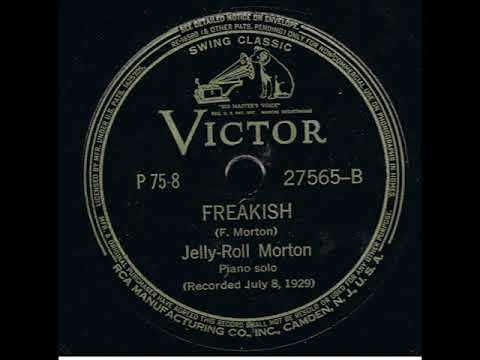
Morton’s melodies are especially reminiscent of the kinds of figures you would find in fiddling. He often plays the melody with the thumb while repeating a pedal note or chord above it or repeats a note with his thumb and plays the melody in other fingers. Omitting these extra notes loses the density of the music and strips it of some of its harmonic nuance. In order to demonstrate some of these ideas more clearly, I recorded several excerpts from Morton’s music during the writing of this article. Take this excerpt from “Freakish”
Other times the melody itself is contained in a series of chords. The entire melody of “King Porter Stomp” is played this way.
When the accompaniment is factored in, this adds up to a music that is at the same time contrapuntal while maintaining a melody and accompaniment. This is where Dielh’s point about voice leading and balance comes in to play. The music is more linearly focused than it is on harmony. If you try to approach it from a standard jazz point of view, playing a melody while thinking about the accompaniment as a set of chord changes, something in the music gets lost.
I still go back to that just to visually see how the voice leading works and try to find different ways of approaching what he’s already established in that particular version because when I think of harmony, it’s definitely more about the line, the movement, than it is about thinking this is G7 going to Ab diminished to A minor or something like that. You can’t oversimplify it like that.
![Jelly Roll Morton - King Porter Stomp - 1924 - [Vocalstyle piano roll n°50480]](https://substackcdn.com/image/fetch/$s_!xIgH!,f_auto,q_auto:good,fl_progressive:steep/https%3A%2F%2Fsubstack-post-media.s3.amazonaws.com%2Fpublic%2Fimages%2F94337f4b-24a2-4183-9657-e85df6f91d60_686x386.jpeg "Jelly Roll Morton - King Porter Stomp - 1924 - [Vocalstyle piano roll n°50480]")
Take for example this excerpt from King Porter Stomp.
There is only one “chord” played in the passage, the C7 in the right hand. But the harmony is still present. It instead emerges from the counterpoint of the fiddle-like melody presentation, and the trombone-like line in the bass. When approaching Morton’s music these kinds of passages cannot be reduced or simplified, as Aaron stated.
The linear focus of his music also makes his music rhythmically challenging. The tresillo and habanera rhythms are often implicit rather than explicit, underpinning the rhythmic accenting of the melody. For example, take this excerpt from “The Pearls”, which has a very rhythmically straightforward tuba-like bass.
![Jelly Roll Morton – The Pearls / King Porter Stomp – Shellac (10", 78 RPM, Reissue), 1944 [r6321500] | Discogs](https://substackcdn.com/image/fetch/$s_!c5no!,f_auto,q_auto:good,fl_progressive:steep/https%3A%2F%2Fsubstack-post-media.s3.amazonaws.com%2Fpublic%2Fimages%2F25308bc5-8e0c-4e28-ba6c-0c18e572c0af_600x600.jpeg "Jelly Roll Morton – The Pearls / King Porter Stomp – Shellac (10\", 78 RPM, Reissue), 1944 [r6321500] | Discogs")
Now hear the same passage with a tresillo accompaniment. The tresillo rhythm lines up with the accents of the melody.
This implicit tresillo laid against a 4/4 “pah, pah, pah, pah” gives his music a rhythmic richness, that also contributes to building an orchestral illusion.
Accenting thus becomes one of the most important elements of his playing. When trying maintain the rhythmic accents, especially in octave passages, it is necessary to play them with minimal pedal. You can’t hide behind the pedal to connect the melodic voices together. They instead need to be connected through legato playing. This kind of playing also requires wrist flexibility to be able to play this kind of repetition of chords without tension. Different hand shapes and the use of the wrist to reach notes instead of jumping are important for maintaining legato. The keys Morton favored also contribute to this sensation of playing his music. Pieces like Winin’ Boy Blues in D-flat major or passages of King Porter Stomp moving through G-flat major lend themselves naturally to dense chordal voicings and sliding inner voices, but are more awkward for flowing lines.
Aaron noted that because of his rhythmic complexity, Jelly’s music sits somewhere in between the straight approach of ragtime and the swing of later jazz eras.
“And it’s not quite swung, it’s not quite straight. The tempo always has to be very specific I think because you don’t ever want it to feel rushed. It also can’t be too lethargic.”
The density of Morton’s playing feels more natural to play at a moderate tempo, and feels straining and taxing at a faster tempo. Despite Morton’s own contention that he did not play as fast as many of the piano players around, Morton did play at tempos that were relatively fast for this style of playing. This is where interpretation and the individuality of the performer comes into play. The tempo of his songs can be flexible and are contingent upon the feeling the pianist can evoke at the chosen tempo. A tempo that is lethargic for one person can be right in the pocket for another pianist. Morton’s tempos can be too fast for some, but they were the right tempo for him. Overall the feeling of the music matters the most.
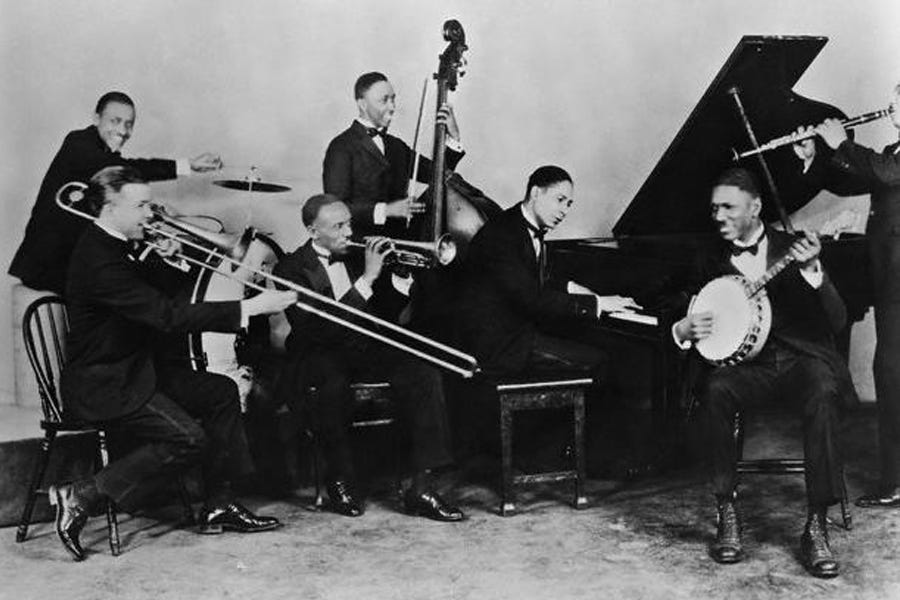
Jelly Roll Morton’s song forms are also much different than how jazz songs evolved to be structured, with a melody and an extended solo section over the melody. His forms are similar to ragtime forms with several contrasting sections which are all repeated. He tends to mix improvisation in with his renditions of the melodies. The improvisation tends to happen in the margins. Aaron described his approach to this aspect of learning Morton’s music:
I think from a combination of recordings that I listen to, I get the melodic material that he likes to keep in. And it’s pretty consistent throughout, and then how he embellishes beyond that. Because again, the soloing, basically, his compositions are one big contrapuntal experience. So the soloing is in between whatever the quote-unquote melody is. Maybe the trumpet has a motif that’s quote-unquote the melody, and then the clarinet is soloing on top of that. And that’s kind of how I think he plays.
The flow of Morton’s soloing tends to be to played freely and then an immediate return to the melody. When playing his music and maintaining the flow his songs, this kind of improvisation structure can feel more restrictive than just soloing over the chord progressions for several choruses.
The deeper I went into Morton’s music, the more I began to realize that the challenges were not merely technical. Morton’s music is a different conception of piano playing than the one most jazz pianists learn and inherit today. This was what fascinated Aaron Diehl most about Morton’s playing. Diehl spoke of his playing as a model for a different approach to jazz piano playing.
I always encourage young pianists, especially jazz pianists, who are more into people like Keith Jarrett or later approaches. I tell them, please go to Jelly Roll Morton. This stuff is just so idiosyncratic, and if you incorporate some of that method, it doesn’t even have to be the exact language, but just that idea of two hands with counterpoint and with an ensemble undertone. I mean, nobody plays like that today, really.
Much of modern jazz pianism, especially after bebop, evolved toward linear conceptions of improvisation. Even solo piano became centered around melodic lines over chordal accompaniment. But what one can learn from Morton’s conception of piano, in its rhythmic and contrapuntal complexity, is how to create the feeling of a dance ensemble.
And people know me for playing solo stride, but I want to kind of think more broadly about solo performance in the quote-unquote jazz context, because Bud Powell, and later people like Herbie, Chick, of course, Keith Jarrett, and certainly now Brad Mehldau. And I’m thinking more about how to create at all times, create the feeling of dance in a solo context.
Like it doesn’t have to be explicit, and always playing some kind of syncopation all the time, but it’s like having that undertone of something that one can dance to, and then taking it one step further. It’s like not only the feeling of dance, but a dance ensemble. And that’s really where the roots of the music are.
The music of Jelly Roll Morton is representative of an older style of playing, but represents the building blocks for what an alternate conception of what jazz piano itself could be.
If you can combine sort of the richness of that orchestral sound and the precision of, instruments blend and orchestration and timbre, phrasing with sort of the more earlier aspects we talk about in the Afro-based traditions, I feel like that’s musical nirvana.
Jelly Roll Morton as a figure has often appeared to people as someone attempting to position himself at the center of jazz history. His claims to have invented jazz appear as hyperbolic and boastful and can feel polemical even today. But when one takes the time to sit down and play his music, to engage with it directly, it becomes clear that his claim was less about literal authorship and more about the world, the people, and the history contained within his playing, the world of New Orleans. To engage with his music is to engage with that history, and even today over a century later, there is still a lot Jelly Roll Morton can teach about what jazz was, and the possibilities jazz can be.
Great series. Thank you! Ahmad Jamal plays orchestrally too!