
Jelly Roll Morton: A Four Part Series — From Reconstruction to Convergence
Part II: How the Collapse of Creole Political Power Gave Birth to a Musical World

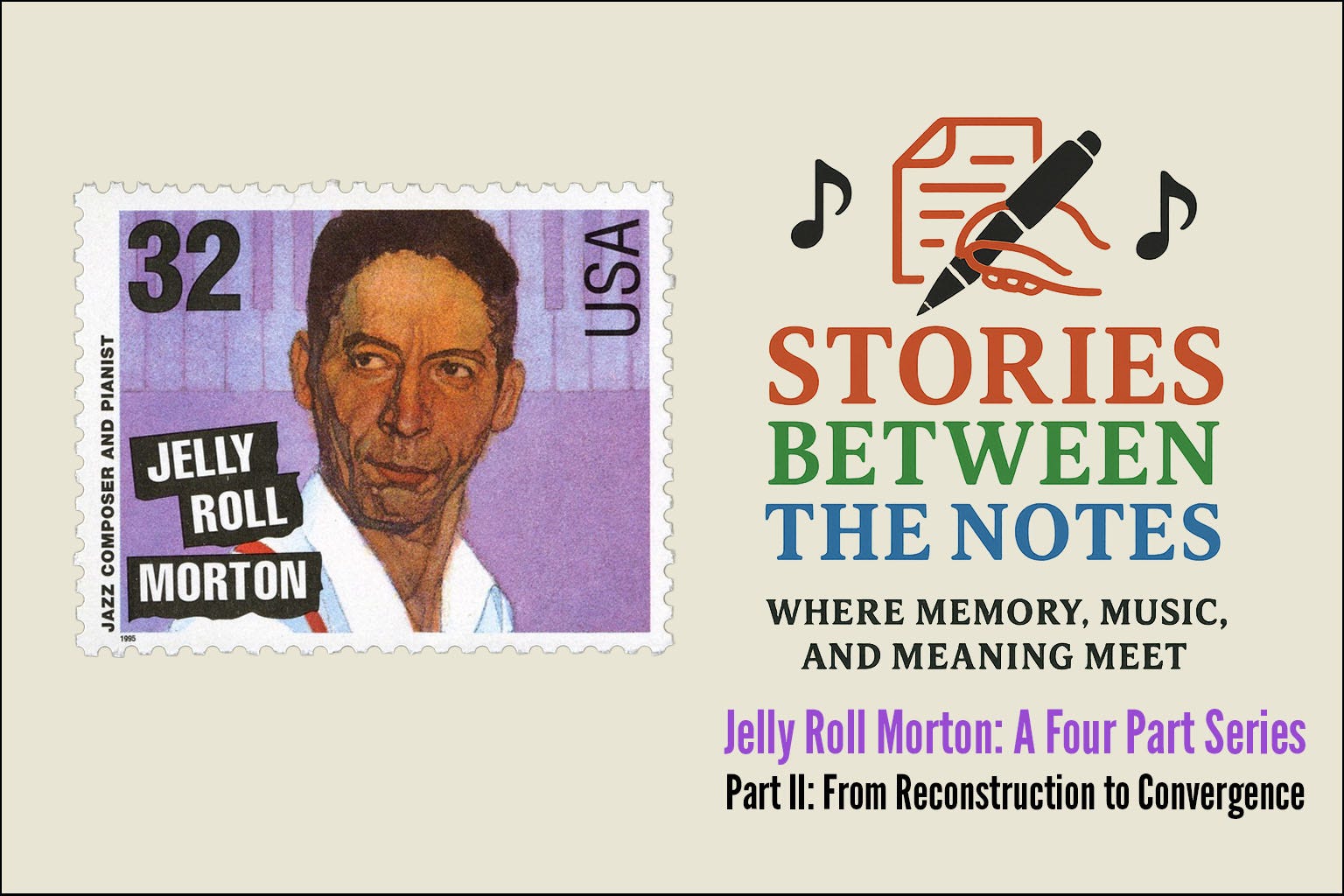
The first part of this series traced the social world of the Louisiana Creoles that produced Jelly Roll Morton. This world was shaped by the complex history of free black and Creole communities in New Orleans, whose education, economic power, and cultural traditions created a unique and distinct way of life within the city.
The Civil War marked a decisive turning point in this history. In the aftermath, the community of people, who had lived in between the margins of the racial and social norms of American society, found themselves, for a brief moment at the center of a new political order. Reconstruction represented an important moment American history across the former Confederacy, as the nation committed itself to realizing the democratic ideals which had long existed in contradiction of the reality of slavery. In Louisiana Reconstruction became an experiment in democracy, where black Americans and Creole people of color actively participated in the governance of the state.
This moment of possibility, however, would prove short lived. Its violent collapse led to the dismantling of not only political power, but the social and economic foundations of Creole life in New Orleans. Yet what was lost did not disappear entirely. The practices central to this world of education, collective participation, and cultural blending, persisted, finding refuge within the domain of music.
The Creole Democratic Experiment
The Civil War saw the destruction of the order established in Louisiana prior to and during the Confederacy. The free black and colored Creole population with its education and economic power, and their militias aiding in the Union victory in Louisiana, were positioned to fill the power vacuum left behind in the wake of the Confederate defeat.
This struggle for control of the power vacuum would begin in 1866 with the reconvening of the 1864 Louisiana Constitutional Convention which had previously voted to establish equal rights and universal male suffrage. The group of Creoles, white Americans, black Americans and recently enfranchised blacks would be met with the beginning of a campaign of white supremacist violence, empowered by the mayor of New Orleans John T. Monroe. The events that followed would become known as the Massacre of 1866. In the essay “Creole Poets on the Verge of a Nation”, Caroline Senter wrote of the massacre:
“When the group began its assault on the assembly, the conveners rushed into Mechanics’ Hall for shelter but ended up trapped inside against the gunfire. One Creole of color was shot while offering a white flag of surrender; other people jumped from second floor windows. In the end, several dozen people were killed and many others wounded.”
Senter would point to this moment as a crucial turning point politically and culturally in Louisiana. The massacre would have wide reaching consequences. Following the sweeping Republican congressional victory, the project of Reconstruction would be instituted across the former Confederacy. As part of the military led Reconstruction, the new regional military commander of Louisiana General Philip Sheridan, would dismiss mayor Monroe and begin building a new government for Louisiana.
But the struggle for democracy was not just confined to political institutions. The massacre led to a strong cultural response by the Creole community of New Orleans, led by the newspaper the Tribune de la Nouvelle-Orleans, the first black daily newspaper in the country, established in 1864. The Tribune led a cultural initiative to push the ideals fought for in the constitutional convention into the foreground of public consciousness.
“In editorials, political news stories, fiction, and poetry published between 1865 and 1868, the Tribune sought to catalyze a nation devoted to racial equality and male suffrage.”
The literature of which poetry was the most prominent reflected the unique historical and cultural experience of the Creole people. Living under French rule until 1803, the Creoles had a direct and tangible connection to both the French and Haitian revolutions, with some having emigrated directly from Haiti. They were written in the French literary traditional of romanticism which was connected to the French and Haitian Revolutions. These revolutions were used as metaphors for the political possibilities of Reconstruction.
These Creole writers saw Reconstruction as part of a national project similar to these revolutions. From an idealistic view, in their multiracial experience as a people, Creoles embodied the nation’s ideals of the inalienable rights of life, liberty, and freedom regardless of social position or race. These Creole writers saw themselves as being in a unique position as Americans to reimagine what the post-Civil War United States could be. The literary program the Tribune launched was first and foremost a nation building project. The newspaper functioned not only as a source of information but as a space of shared civic imagination, uniting its readers in a collective vision of democracy.
This literary consciousness was also mirrored in direct political involvement of Creoles within the project of Reconstruction in Louisiana. As the Union military assumed control of the state following the Massacre of 1866 under General Philip Sheridan, among the people appointed to government positions were colored Creoles. This led to the first instance of legal voting registered by a black individual in the history of the United States at the Constitutional Convention of 1868, were blacks and colored Creoles voted for their delegates to represent their interests. Alice Dunbar-Nelson in her history of the Creole people,"People of Color in Louisiana”, wrote:
“He appointed a new board of aldermen, some of whom were men of color, and in the next month this council appointed four assistant recorders, three of whom were colored, and two colored city physicians. In this month, September, 1867, the first legal voting of the colored man under the United States Government was recorded, that being their voting for delegates to the Constitutional Convention of 1868.”
This Constitutional Convention ratified the Fourteenth amendment in Louisiana, with more than half of the members in attendance being blacks and Creoles people of color. This would mark the high point for the democratic aspirations of blacks and Creoles in New Orleans during construction. The Tribune reported the significance of this moment:
“This will be the first constitutional body ever convened in the United States without discrimination of race or color. It will be the first mixed assembly clothed with a public character. As such, this convention has to take a position in immediate contradiction to the white man’s government. They will show that a new order of things will succeed the former order and that the long-neglected race will effectually share in the government of the state . . .”
It is of note that among the people in attendance of his moment was the grandfather of Jelly Roll Morton, Henri Monette, who would have been beside many others from his community, the grandfathers of the first generation of jazz musicians in New Orleans.
This moment of triumph over the institutionalized white supremacy in Louisiana would be short lived. The ideals espoused by the writers of the Tribune would also come into conflict with the racial ideology of the United States and the hugely polarized political climate surrounding race. Political coalitions would begin to take shape directly aimed at the otherness of the French and Haitian cultural and artistic expressions of the Creoles. The Tribune came under fire from all directions as Creoles were under intense pressure to assimilate into American norms. They became problematic for the Union, growing tired of its commitment to Reconstruction as a whole, and the resurgence of the southern planter class whose ideology and ideals were directly threatened by a successful integrated democracy. As Caroline Senter writes:
“As racial and regional alliances formed after the war, the newspaper came under increasing attack from Creoles of color, African Americans, and white Creoles and Americans. Non-Creole African Americans in Louisiana aligned with northern, Protestant African Americans, and chose a clearly marked racial position encouraged by northern and southern whites….Eventually losing its base of support within a community pressured to assimilate, the paper ceased publication in 1868. The poems show us that the rigid racial delineation which enabled the subsequent subordination of black citizens under Jim Crow was beginning to occur even at this early stage in Reconstruction.”
The convention set into motion a political upheaval amongst whites in Louisiana which would lead to the downfall of the Louisiana State legislature and the dismissing of all black public officials in 1874, following the state’s repression of the white supremacist rebellion of the Battle of Liberty Palace.
Despite the collapse of Creole political power, the democratic vision articulated during Reconstruction did not disappear. Deprived of institutional expression, it persisted in cultural form, in the musical culture of New Orleans.
The Creole Musical World
To give context for the emergence of jazz, it is necessary to understand the Creole music infrastructure, within New Orleans before and after the Civil War and what they contributed to the overall music culture of New Orleans. Alongside the many musical traditions within New Orleans, existed an economy around the training of professional musicians, the performance of “concert” dance music, and publication of sheet music, which supported a wider entertainment scene.
Lester Sullivan in his essay “Composers of Color of Nineteenth-Century New Orleans: The History Behind the Music” describes this music as follows:
“Essentially genteel entertainment music on the European model, it is now sometimes called “concert” music, but a person was as likely to encounter this music at the theater as at the concert hall. Likewise, the term “salon” music does not always apply, because some of it was dance music, frequently heard in the ballroom. The genteel sheet music repertoire in New Orleans in the 1800s consisted almost entirely of dances for piano, piano scores of marches with occasional instrumental indications, and songs with piano accompaniment. The emphasis was on dance.”
Sullivan made a point to not confuse this 19th century genteel music with how classical music is regarded and understood today. Generally in the 19th century, the separation between popular music and art was not as clear and rigid as it is understood today. Even within what we would understand as classical music, there was a spectrum of music from popular entertainment like comic opera and operetta, to serious composition such as symphonies and Grand Opera and often the line was blurred between them.
The 19th century genteel music is often overlooked within New Orleans music history, but demonstrates the kind of musical infrastructure and institutions that existed and gives greater context for the class of musically trained artisans that made up the Creoles up to the early days of jazz. This also gives insight into the musical pedagogical tradition that existed within the city.
The white Creole pianist Louis Moreau Gottschalk, who I have written about previously is an example of a composer in this model. Though he was influenced by the different music traditions that existed alongside the formal classical education he received, the framework in which he composed remained European in reference, whether he was composing a polka or a bamboula. Louis Moreau Gottschalk also demonstrates that the combination of European forms and African-derived rhythms already existed within this musical world prior to jazz.
A parallel to understand this music would be the 19th and early 20th century music in the wider Caribbean and Latin American world, which combined African rhythms with European forms such as the polkas, waltzes, tangos, maxixes, and marchinhas of a Brazilian composer such as Chiquinha Gonzaga, widely considered one of the first choro composers.
It is important to understand New Orleans as part of this greater Afro-Atlantic musical continuum rather than being limited to an American phenomenon. Italian musicologist Luca Cerchiari in his article “The “French tinge”. Jazz and its Paris-New Orleans connection” argued that “it is necessary in dealing with early jazz in New Orleans, to consider the fact that jazz was born as a synthesis of previous and parallel musical genres, of written and oral sources, of European, African and Caribbean traditions.”
The concert musical traditions in New Orleans and pedagogy within the Creole music world can be seen in the training and careers of musicians such as Edmond Dédé and Charles Lucien Lambert. Their education reflects a system of musical training amongst the Creoles of color which was integrated into a wider western musical tradition extending back to France and the prevalence of musical institutions within New Orleans.
Dédé, for instance, studied under the Italian-born composer Ludovico Gabici, the Creole conductor Constantin Debergue of the Philharmonic Society, and the French Prix de Rome laureate Eugène Prévost, who directed both the Théâtre d’Orléans and the French Opera. Similarly, Lambert and his half-brother Sidney were trained by their father, Charles Richard Lambert, himself an important musical instructor, and developed their skills performing in the orchestra pit of the Théâtre d’Orléans.
This musical world extended beyond New Orleans itself. Dédé continued his studies at the Paris Conservatoire before establishing a career in Bordeaux, a city with strong commercial and cultural ties to New Orleans at the time, while Lambert built a career spanning Paris and Rio de Janeiro, where he contributed to the development of piano traditions through his teaching of figures such as Ernesto Nazareth; Lambert himself later became a member of the Brazilian National Institute of Music.
Sullivan credits Lambert with instilling in Nazareth a love of a style of American piano playing associated with Gottschalk, who also lived and performed in Rio de Janeiro at the time, called style pianola, which is loosely known today as “salon music”.
“Now that Nazareth’s piano music is enjoying a revival on recordings, it has become increasingly evident that he may have gained from Lambert not only his love for Chopin but also an inclination toward the style pianola, which, coupled with Gottschalk’s pioneering use of American color in his compositions, suggests a line of influence from Lambert pere and Gottschalk to Nazareth…”
During a return visit in 1893, Dédé performed with the pianist William J. Nickerson, a product of this same musical tradition, who would later become the teacher of Jelly Roll Morton. The careers of these musicians show an interconnected musical world and traditions that linked New Orleans to France, the Caribbean, and Latin America, and which would ultimately form the musical foundation inherited and transformed by later musicians such as Morton.
The Rise of the Brass Band
While this pedagogical tradition provided a foundation for musical life in New Orleans, the aftermath of the Civil War and Reconstruction reshaped the social conditions of the city. The traditions of the theater, ballroom, and salon did not disappear, but were incorporated into different settings, forming the practices and repertoire of the growing prominence of brass bands across New Orleans.
There was a growth in the availability of instruments from the Confederate army in pawnshops across the city, and Creoles of color were part of the population who could afford musical instruments and lessons for their children. The bands that would begin to form were part of a wider growth of brass and military bands that were becoming fashionable throughout the United States. The New Orleans bands would have been formed in this mold, but its musicians would have been trained more in French music traditions as previous eras of Creole musicians were. As shown before, many of the musical teachers throughout the 19th century were themselves trained in a French tradition, studied in France directly, or studied with a teacher who had. Luca Cerchiari noted:
“French was Mathieu-Auguste Panseron (1795-1859), a singer and vocal teacher, whose method for solfège was widespread in the New Orleans musicians’ community, including creole and black early jazz instrumentalists. It was more than likely that many of the components of the renamed New Orleans brass bands and marching bands used to study on such methods.”
Cerchiari also places the bands in a greater context of the growth of brass bands and marching bands across the United States following the Civil War beginning with John Philip Sousa’s United States Marine Band. These bands formed an important and distinct part of the wider American musical tradition and identity of this time period. The repertoire of these bands would have been diverse from marches to European dances, arrangements from operas and classical compositions, and popular songs such as the songs of Stephen Foster.
New Orleans and the surrounding areas transformed into a world of music, with the propagation of brass bands and string orchestras. All the various cultural and musical influences that floated around the Creole quarter began to coalesce into the growth of a distinct musical tradition. As Alice Moore Dunbar-Nelson’s wrote of the Creole people, their music was very much like her description - “is like the famous gumbo of the state, a little bit of everything, making a whole, delightfully flavored, quite distinctive, and wholly unique”. Alan Lomax described the tradition and the many ingredients that contributed to its development in late 19th century New Orleans:
“A strong tradition took form, and was passed on to eager apprentices, continually enriched by cosmopolitan musical currents from everywhere, and yet maintaining its local character. French opera and popular song and Neapolitan music, African drumming (still to be heard at voodoo dances on Congo Square where Jelly was born), Haitian rhythm and Cuban melody, native Creole satiric ditties, American spirituals and blues, the ragtime and the popular music of the day—all these sounded side by side in the streets of New Orleans and blended in the rich gumbo of New Orleans music. The people made a fine human gallimaufry, too.”
The blending of musical traditions was not something unique to the history of the development of jazz, but reflected a broader condition of American musical life in the nineteenth century. In a society shaped by immigration, migration, slavery, and cultural exchange, different musical systems were continually brought into contact. American brass bands, for instance, routinely combined marches, operatic excerpts, and popular melodies, while the musical life of New Orleans existed as a dense convergence of African, Caribbean, European, and American styles. What distinguished early jazz was not the mixture itself, but the way musicians worked with it. As Jelly Roll Morton often suggested, jazz was less of a style defined by repertoire, than it was a way of playing, a method of transforming existing material.
How early jazz musicians transformed the nineteenth century genteel music
To understand how this process of transformation operated in practice, it is necessary to look at the musical forms that early jazz musicians inherited. In his interviews with Alan Lomax, Jelly Roll Morton offers a clear example of this process, describing how the song Tiger Rag was transformed from a French dance popular in New Orleans known as the quadrille.
The term quadrille originates from 17th century military parades where men on horseback performed maneuvers in square patterns. This eventually evolved into a dance when it was introduced into France in the 18th century. The dance was known as the “quadrille des contredanses”, involving four couples, in which a “head” couple performs a dance figure which is repeated by the “side” couples. Musically, a quadrille involves several melodies based on popular dances or popular songs.
Jelly Roll Morton’s explanation of the quadrille aligns with this general outline. There was a head melody that was played to announce to the party that people should find their partners. After a repetition of this head melody, a different melody over a waltz was then played, followed by a mazurka, a cut time dance, and several other dances that Morton doesn’t name. Eventually these different dances were brought together into a multi-strain ragtime form and transformed. Despite Morton’s claim of authorship, the song itself is generally considered a collective creation of different musicians over time. The general structure of the song as we know it today is a structure Morton often uses in his songs. His specific influence is probably more in the structure and pianisms than in the actual composition itself.
What Morton does show though is the transformation of popular dance music, which in the 19th century would have spanned from European dances like waltzes, mazurkas, and polkas, to American dances like jigs, cakewalks, and two-steps. These dances were transformed over time into songs such as Tiger Rag.
It is also important to note that improvisation was a skill that was prevalent amongst musicians of the 19th century. The European classical traditions of improvisation, which developed out of Italian partimento traditions, were still taught, handed down from master to pupil, and formed an important part of teaching at conservatories such as the Paris Conservatory. Improvisation in this time was expected of musicians and was still an important part of performance. These dances, rather than being set compositions, as we would imagine them today, would have been common melodies and songs, improvised over and iterated upon, ornamenting and transforming the melodies.
An example of this kind of improvisation in the classical music canon can be found in the form of theme and variation, especially by virtuosic pianists such as Frederic Chopin and Franz Liszt. Chopin’s Berceuse or Liszt’s Variations on a Theme by Paganini are great examples of the ways in they would have improvised and the pianisms they would have deployed. There even exists a transcription of Chopin’s improvisation over his famous Nocturne in E flat major. The transcription was recorded by Polish pianist Raoul Koczalski. Heavily ornamented melodic passages also give insight into the kinds of figures and pianisms that would have been common at this time. If one looks at the music of composers such as Austrian composer Johann Hummel , Czech composer Jan Ladislav Dussek , Irish composer John Field, the common musical language across Europe, becomes more apparent, rather than attributing it solely to composers prominent in today’s repertoire like Chopin and Liszt.
The kind of embellishments pianists like Jelly Roll Morton would make operated on a similar principle but with major stylistic difference. If you substitute the idea of “riffs” which Jelly Roll Morton explains are typical melodic figures that were used to create and ornament melodies. One can hear this clearly in his rendition of Tiger Rag in how it differs from his demonstration of the song’s origins. It can also be seen clearly in how he transforms Scott Joplin’s famous rag, Maple Leaf Rag, which features many “riffs” Morton deployed across his music.
This kind of transformation was not limited to the piano tradition, but applied to the instruments common in New Orleans bands, like the clarinet, trumpet, and trombone developing distinct ways of playing these instruments and improvising. Perhaps one of the most important and consequential instrumentalists in the development of jazz as a music was the cornetist Buddy Bolden. Much like Morton described, Bolden improvised and embellished over popular songs and standard structures adding elements from blues and music of the church. Bolden brought a rough edge to the music of early jazz. He was the most popular musician in New Orleans around the turn of the century and the kind of playing we associate with the New Orleans jazz trumpet playing in figures like King Oliver and Louis Armstrong, with the strong vibrato, bending of notes and the use of mutes for wah-wah effects was developed by Bolden. Though no recordings of Bolden survive today, one can see his direct influence on King Oliver’s playing like his “wah-wah” solo in Dippermouth Blues. In this recording amongst the collective improvisation, one can also hear the prevalence of the “riffs” that Jelly Roll Morton used in his own playing, once again showing the common language that the musicians in this time were pulling from.
Crossing Canal Street
In the narrative of jazz history, the red-light district of Storyville is often identified as the birthplace of jazz. Despite the Jim Crow segregation laws of Louisiana, the brothel houses that catered to white clientele would allow black musicians to perform. Madam Lulu White’s Mahogany Hall employed a teenaged Jelly Roll Morton, a fact that famously led to Morton’s expulsion from his grandmother’s home.
Yet to understand Storyville as the singular birthplace of jazz is to misunderstand its historical role. Jazz did not suddenly emerge there but rather, Storyville functioned as a point of convergence, where existing musical, social, and economic forces were brought into contact.
As writer and New Orleans native, Randy Fertel argues, in his Substack article NOLA Jazz and its Neighborhoods: The Role of S. Rampart St. , Storyville’s significance lies in its position between a network of neighborhoods, close in terms of proximity, but far apart in terms of their social worlds. The geography and social tensions shaped the development of jazz as a music.
New Orleans as a city is divided by Canal Street, which separates the French speaking Creoles from the Americans, whom the locals referred to as “Kaintucks” because of the prevalence of people from Kentucky flowing into New Orleans down the Ohio and into the Mississippi river. Fertel writes:
“The Creoles marked the distinction by comparing their commitment to savoir vivre—how to live well—to the American commitment to savoir faire—how to make and do, especially how to make the American dollar…So Canal Street marked the boundary between two worlds: the Creole, French speaking world that looked fondly back to colonial times, and the English speaking American world that excitedly looked ahead to American capital and empire.”
Fertel also notes that Canal Street also separated musicians between those who could read notated music scores, mostly of colored Creole origin, and musicians who could not, the descendants of the enslaved in New Orleans, and those emancipated in other parts of the South, who migrated to escape the growing brutality of the Jim Crow regimes.
The Creole musicians were the inheritors of an institutional musical system tied to musical literacy, and a cosmopolitan Afro-Atlantic world. The uptown musicians had developed out of the rhythmic and expressive traditions rooted in Congo Square and survived through the Spiritualist churches following Congo Square’s permanent shutdown in 1856.
Fertel emphasizes that the geography of the city and the social divides led to several birthplaces of jazz with Southern Rampart Street, and Back a’Town being central to this. Back a’Town was the unofficial black Storyville, that existed before Storyville’s 1897 opening. The specific hubs such as Back a’Town, Economy Hall, Storyville, provided spaces that bridged neighborhoods, which were close in proximity, but far apart socially.
By the 1890s, as Lomax describes, the economic position of the Creole population had deteriorated significantly. Having been displaced from their traditional trade and artisan “day jobs” many Creole musicians were compelled to turn to music as their primary means of livelihood. At the same time, black American musicians were entering the same labor market, competing for the same jobs. Storyville, one of the hubs of social convergence in the divides of New Orleans, is one of the places where this competition became unavoidable. It offered regular and relatively well-paid work to musicians willing to perform in its dance halls and brothels.
This environment was marked by tensions shaped by the city’s history. As Lomax notes, Creole musicians often held on to their caste prejudices, which dated back to the French and Spanish colonial eras, even as their own social position eroded. At the same time, black American musicians from uptown asserted their presence through the sheer excellence of their performance abilities. In a world where musical talent was one of the main social currencies, ability had to be recognized regardless of background. The music spoke, first and foremost.
Fertel captured this moment symbolically in an encounter between Jelly Roll Morton and a nine year old Louis Armstrong on South Rampart Street, where Armstrong would walk along with his “spasms band”, a kind of band often made of children, who played instruments made from household objects. Armstrong’s singing was so striking that a friend brought Jelly Roll Morton from Storyville across Canal Street to hear him.
Reflecting on the significance of this moment, Fertel writes:
“So, in my imagination I take that moment when Jelly Roll witnessed Little Louis’s spasm band as the moment when the downtown Creoles began to wonder if they had something to learn from uptown.”
While no one moment can be credited with being the exact starting point of jazz, there is symbolic significance in this moment, not just in the convergence of two parallel music and social worlds. But also the symbolic meeting of jazz’s early great ambassadors, one bringing the music outward from New Orleans across the country, the other who would bring it with him across the world.
This is brilliant, informative writing. Salut!