
Why Cherokee?
How did Cherokee become the jam session warhorse it is today?

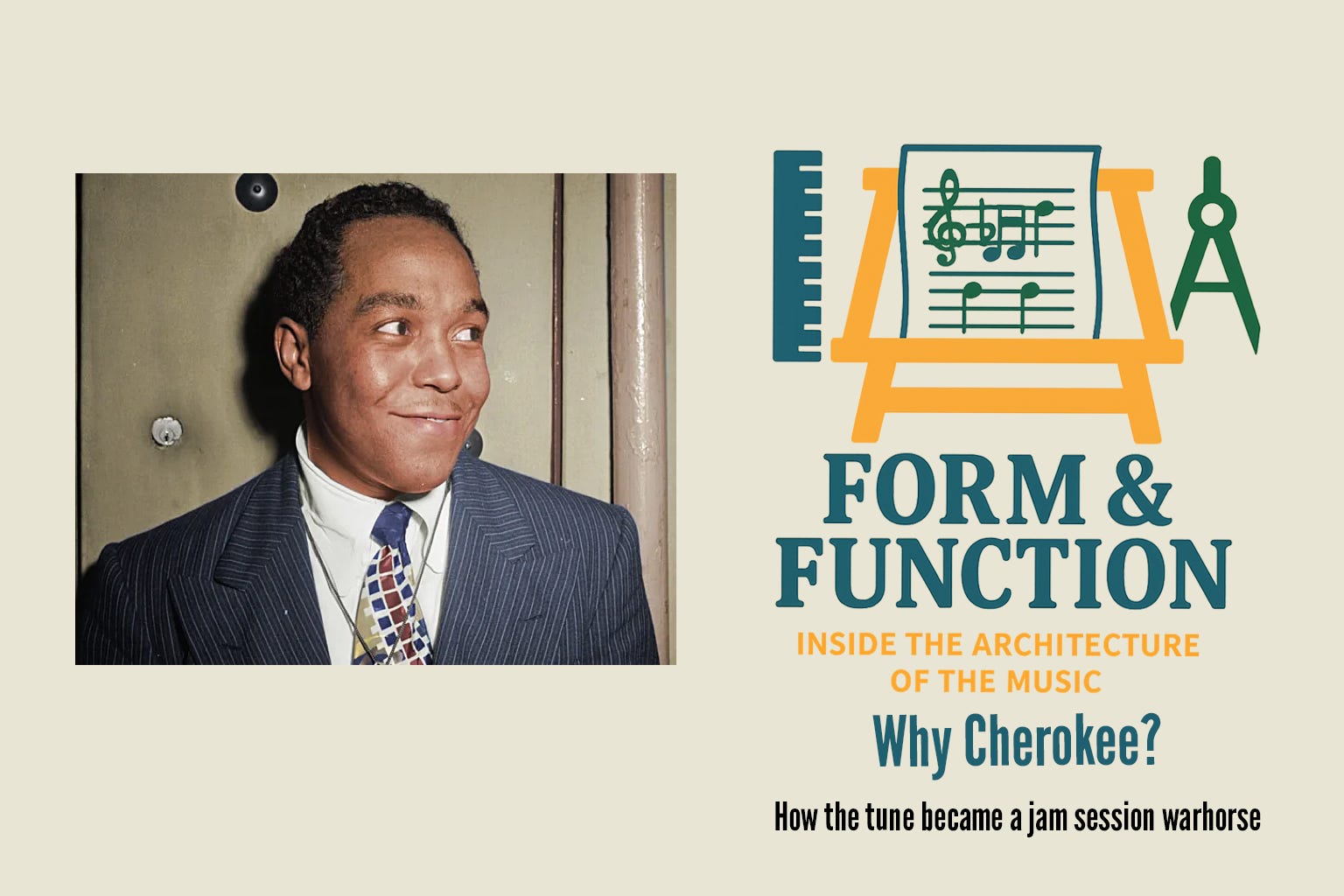
One day while filing through the discographies of different jazz pianists, I began to notice a pattern of recurring songs in each pianists’ catalogue. These songs for whatever reason, were songs to which these pianists almost always committed some level of violence. They would attack them with such speed and virtuosity that it made me wonder if it was ever this necessary to prove a point of how good someone was. These songs were mostly quaint little tunes like “Tea for Two” and “Sweet Georgia Brown”. “What did these songs ever do to anybody?” I wondered. (I’m looking at you Oscar Peterson!)
Of course, I realized that the person we must blame for this is none other than Art Tatum, who left such an indelible mark on certain songs that no one could touch them without having to contend with his influence. Certain songs become proving grounds for young musicians and seasoned veterans alike to show what they can do.
Possibly one of the most famous songs of this kind is “Cherokee”. Like the others that always seem to trigger a bout of insanity from Oscar Peterson’s fingers, “Cherokee” is a song that has become a mainstay in jam sessions. What better way to test someone’s mettle than to call such a well-known up-tempo standard like this one? I’ve long accepted this as a fact life without once ever questioning it. But after hearing enough recordings and live performances of people going absolutely berserk on “Cherokee” (I’m looking at you Marcus Roberts!), I began to wonder, “Why Cherokee?”
It’s almost a cliché at this point to write about the “complex” harmonies of the song. But upon a casual listen it doesn’t bear the hallmarks of a “difficult” song. It doesn’t have an intricate melody like “Little Willie Leaps” or consistently difficult chord changes that fly by like “Giant Steps”. Its difficulty lies not in the chords themselves, but in the exquisite pacing of the harmony.
“Cherokee” has its roots in big band music, written by English bandleader and composer, Ray Noble, who recorded the song in 1938. But it wasn’t until a year later when trumpeter Billy May wrote an arrangement for Charlie Barnet and His Orchestra that the song would see popularity. It even reached as high as number 15 on the pop charts!
“Cherokee” was a smooth song which relished its gradual shifts in harmony. The big band arrangements emphasized this in how the saxophones harmonized the melody, adding rich dissonances at key points and resolving them in satisfying ways. This kind of harmonic sweetness makes sense given the song’s origins as “an Indian love song” written by an English jazz musician. The hints of exoticism and romanticism are infused.
For a soloist though, these slow and steady changes in harmony can lead to meandering lines and stagnation of ideas over the lingering B flat chords in the first half of the melody in the A section. But right when you’re lulled into complacency, the rate of change in the chord progression picks up to end the first A section. This trick of building tension through the harmonic rate of change is a staple of western classical music. Just listen to any passage of a piece by any composer from Mozart to Brucker and you’ll hear this equilibrium and flow in harmonic motion.
When the bridge arrives the regularity of chord changes is established, with a succession of ii-V progressions, the building blocks of bebop harmonic progressions. But the soloist cannot relax here! This section is made more difficult beginning over a C sharp minor 7 chord. This sudden change from the sonic world of B flat to the C sharp minor 7 chord brings a surprising and refreshing sonority breathing a new bought of life into the song sounding about as far away as you can get from the first section. This shift in sonority also serves to create anticipation to the arrival back to the home key of B flat, creating a satisfying resolution back to the final A section.
This basic dynamic of stasis and rapid change is what makes “Cherokee” such a wonderful tune to listen to at any tempo, and is what makes it so difficult to solo over. But to elevate the song to a jam session warhorse, we have to add the missing ingredient: an encounter with a legend. Unlike many songs in jazz piano history, this legend does not go by the name of Art Tatum! Tatum’s version of the song leans more into harmonic complexity than it does into virtuosity for Tatum standards at least! Enter a young Charlie Parker of twenty-one odd years.
Over his time of playing in Jay McShann’s Orchestra, Parker had made “Cherokee” his own show tune. It was an arrangement that was intended to make him shine and Parker rarely disappointed (at least on the bandstand). In the biography Kansas City Lightning: The Rise and Times of Charlie Parker, the late great author and jazz critic Stanley Crouch tells a riveting tale of how Charlie Parker conquered “Cherokee” once and for all and in an instance changed jazz history.
On one fateful Sunday at 4:30 pm, during a short fifteen-minute radio broadcast of the Jay McShann Orchestra from the Savoy Ballroom, McShann had planned to open the set with “Cherokee” to show off their young star saxophonist. But as the set began, Parker was nowhere to be seen. Furious from the volatility of dealing with Parker on account of his drug addiction, pianist Jay McShann and the rest of the rhythm section decided to show Parker up, when he appeared at the ultimate moment. As Crouch illustrates:
McShann stomped off a furious tempo. “This wasn’t one of those slow- trains-through-Arkansas tempos,” recalled Ramey. “This was like that train between Chicago and Milwaukee. I mean fast!”…Arrogant and proud of themselves, the rhythm section reared back and pounced on Charlie’s back when he put his horn to his mouth. And his saxophone, in turn, became a flamethrower of rhythm, melody, and harmony. They pushed and drove, chorus after chorus. Then, as professional experience had taught them, they lulled, let him get a little stronger, went back to their basic strategy, and let him dance his hot-footed dance with subtle support. Then they tore into him again, setting fire to his tail. …Each chorus was getting hotter; it was clear, from the position of his body and the sound of his horn, that Charlie Parker was not going to give in. All the nights he had worked on it, the flubs, the fumblings, the sore lips, mouth, and tongue, the cramped fingers—they all paid off that afternoon. Suddenly, the man with the headphones was signaling McShann, Don’t stop! Don’t stop! Keep on playing!
That afternoon, sixteen miles away from Harlem, bassist Chubby Jackson was working at the Adams Theatre in Newark. He was playing with the big band led by Charlie Barnet, who had had a hit with “Cherokee” two years before. While on break, Jackson decided to see if that new band playing opposite Lucky Millinder was showing anything special on the Savoy broadcast. McShann’s version was that of an alto saxophone almost completely devoid of vibrato, notes flying thick as buckshot, slapping chords this way and that, rambling quicker and with more different kinds of rhythms than his band had ever heard from a saxophone. Everybody stopped talking, fiddling with their instruments. Who the hell is this?
From this moment onward, the song “Cherokee” was never the same. Whenever a jazz musician steps onto bandstand, be it jam session or concert, when they count off the blistering tempo for which Cherokee has become renown, they are inevitably attempting to outrun the long shadow cast by the legend of Charlie Parker.