

Editor’s Note
The first two articles in this series of each installment will be free to everyone. The complete series, including the exclusive unabridged interview with Wynton Marsalis, will only be available to paid subscribers.
Assembling a series like this takes months of interviews, research, and writing. If you’d like to journey with me through the entire project and support this type of in-depth music journalism, please consider signing up for a paid subscription.
I’ve lived much of my life in the shadow of my name, as I’ve written on previously. I was named after two great Wyntons. Wynton Kelly the pianist, and Wynton Marsalis the trumpeter and composer. Becoming a musician and composer with this name has meant carrying both its weight and its expectations. No matter where I go though, my connection to Wynton Marsalis always comes up. When I began my Master’s degree in London, it took less than two weeks for a rumor to spread that I was Wynton’s godson. Even my composition teacher asked if it was true! For better or worse, I am bound to him.
Wynton has been one of my most important mentors, alongside musicians and teachers who shaped my path from an early age. I cut my teeth as a middle schooler transcribing his septet music, and he expanded my artistic world beyond music itself, taking me to museums and giving impromptu lessons in literature and film. Those experiences shaped not only my musical education but also my broader aesthetic outlook.
Alongside that background, I’ve studied jazz and classical piano, composition at the undergraduate and master’s level, and now contemporary history at the doctoral level. This project is where I bring those experiences together offering a perspective not only on Wynton’s music, but on the world around it.
Whatever one’s opinion of Wynton, it is undeniable that he is among the most important and consequential musicians and composers in jazz today. His body of work, and his role in shaping how jazz is viewed and received by a global audience, has no true contemporary parallel.
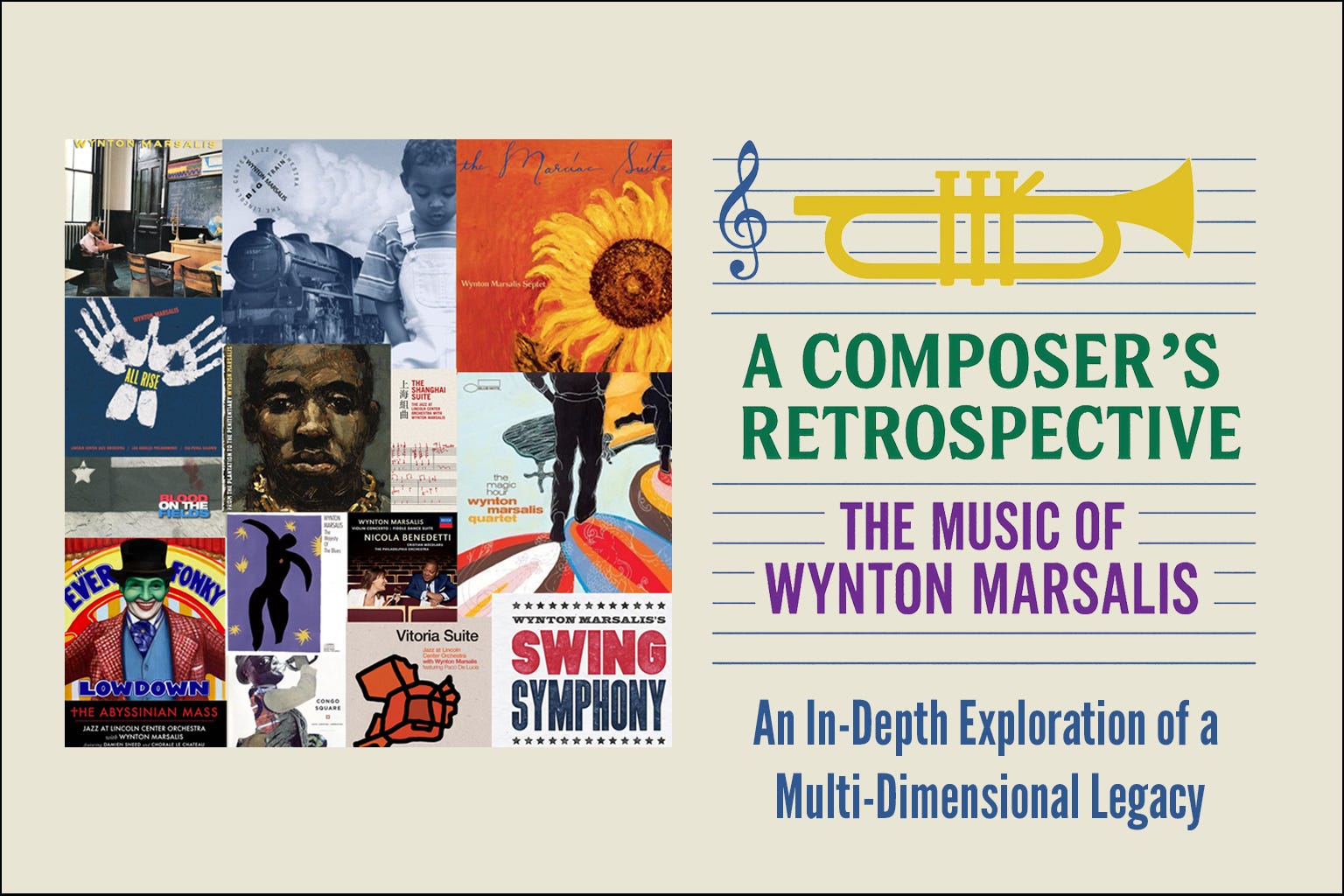
This series will explore his evolution as a composer through a curated sequence of landmark recordings. From small-group writing to orchestral works, I’ll look at how his music engages with structure, purpose, and the broader cultural and critical contexts in which it lives.
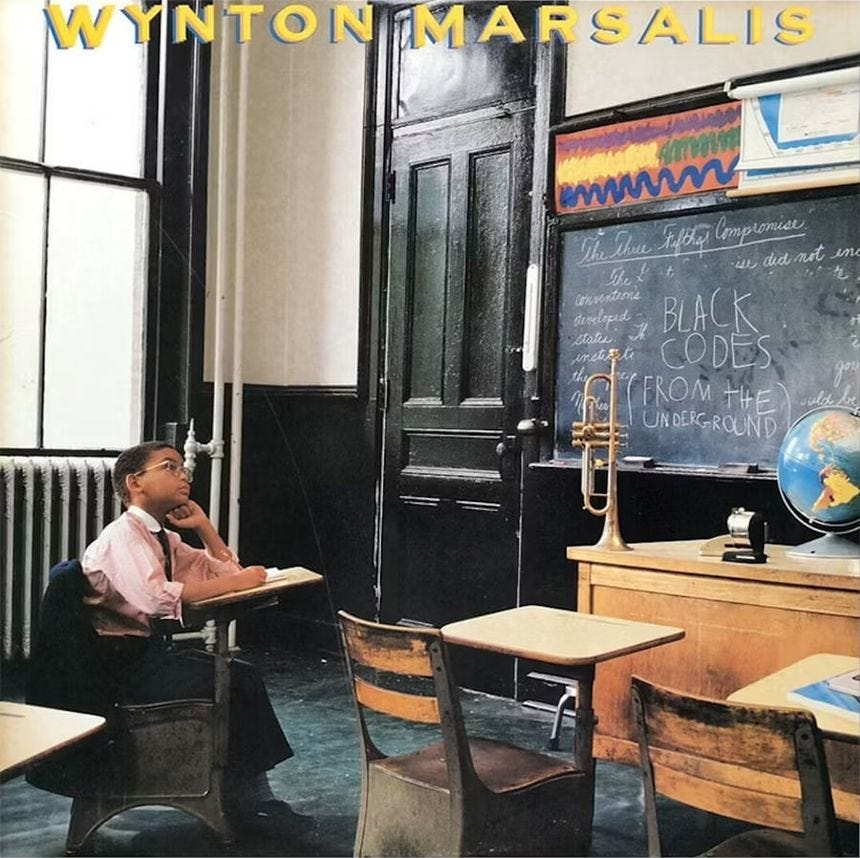
The first entry focuses on Black Codes (From the Underground), released 40 years ago in 1985. Aside from it being his first recording with all original compositions (all by him except for one), it also marks an inflection point. Here, Wynton begins to step out of the image of the “Young Lions” and the post-bop revival of the early 1980s, toward the musician most people recognize today as the artistic director of Jazz at Lincoln Center, leader of the Jazz at Lincoln Center Orchestra, and a central figure at the forefront of the preservation and institutionalization of jazz as an art form within the wider American cultural pantheon. In Black Codes lie the seeds of the next forty years of his career.
Part I explores the cultural and musical context of the early to mid 1980s, a pivotal but often overlooked moment in jazz history. Featuring insights from trumpeter and educator Mondre Moffett, drummer Jeff “Tain” Watts (who played on the album), and saxophonist Branford Marsalis, this opening examines the emergence of the “Young Lions” generation and Wynton’s approach of “playing to the future by studying the past”: an approach that drew both excitement and fierce criticism from figures and cultural critics.
Part II analyzes the music itself, its influences, innovations, and how it establishes the core characteristics of Wynton’s compositional voice. Through conversations with Watts, Branford Marsalis, and Mondre Moffett, this section reveals the album as standing at a crossroads between the controlled freedom of Miles Davis’ Second Great Quintet and the spiritual intensity of John Coltrane’s quartet, a synthesis of formalism and ferocity that shaped Wynton’s emerging compositional identity.
Part III examines the chemistry of the quintet itself, the contrasting and symbiotic relationship between Wynton and Branford, and the extraordinary rhythm section of teenage prodigy Charnett Moffett, veteran mastermind Kenny Kirkland, and the polyrhythmic Jeff “Tain” Watts. Drawing on recollections from Mondre Moffett, Branford, and Tain, this section reveals how the band embodied a concept sometimes referred to as “burnout”, a balance of personal freedom and collective participation that evolved the innovations of the 1960s into something entirely new.
Part IV traces the album’s critical reception from its 1985 release through its 2023 induction into the Library of Congress’ National Recording Registry. This section explores how perceptions evolved from debates over tradition versus innovation to recognition of the album as a foundational moment in Wynton’s legendary career.
Part V captures how today’s young jazz musicians view the album and what it means for their own understanding of jazz. Through conversations with trumpeters Keyon Harrold, Dave Adewumi, saxophonists Julian Lee, Birsa Chatterjee, and Marcus Strickland; pianists Emmet Cohen, Isaiah Thompson, and Davis Whitfield; bassist Russell Hall; and drummer Ryan Sands, this section explores how a new generation approaches questions of authenticity, artistic responsibility, and the spiritual dimension of the music.
Part VI concludes with an unabridged interview with Wynton Marsalis himself.
Support This Work
This series represents many years of study, reflection, and personal connection, and each article is the result of significant time and care. Because of that work, and to sustain future writing at this level, the full series will be available only to paid subscribers. I hope you’ll consider supporting the project by subscribing — not only to gain access to the complete series, but to help make it possible to continue producing thoughtful, in-depth explorations like this.
Wynton on Wynton! Looking forward to this series.