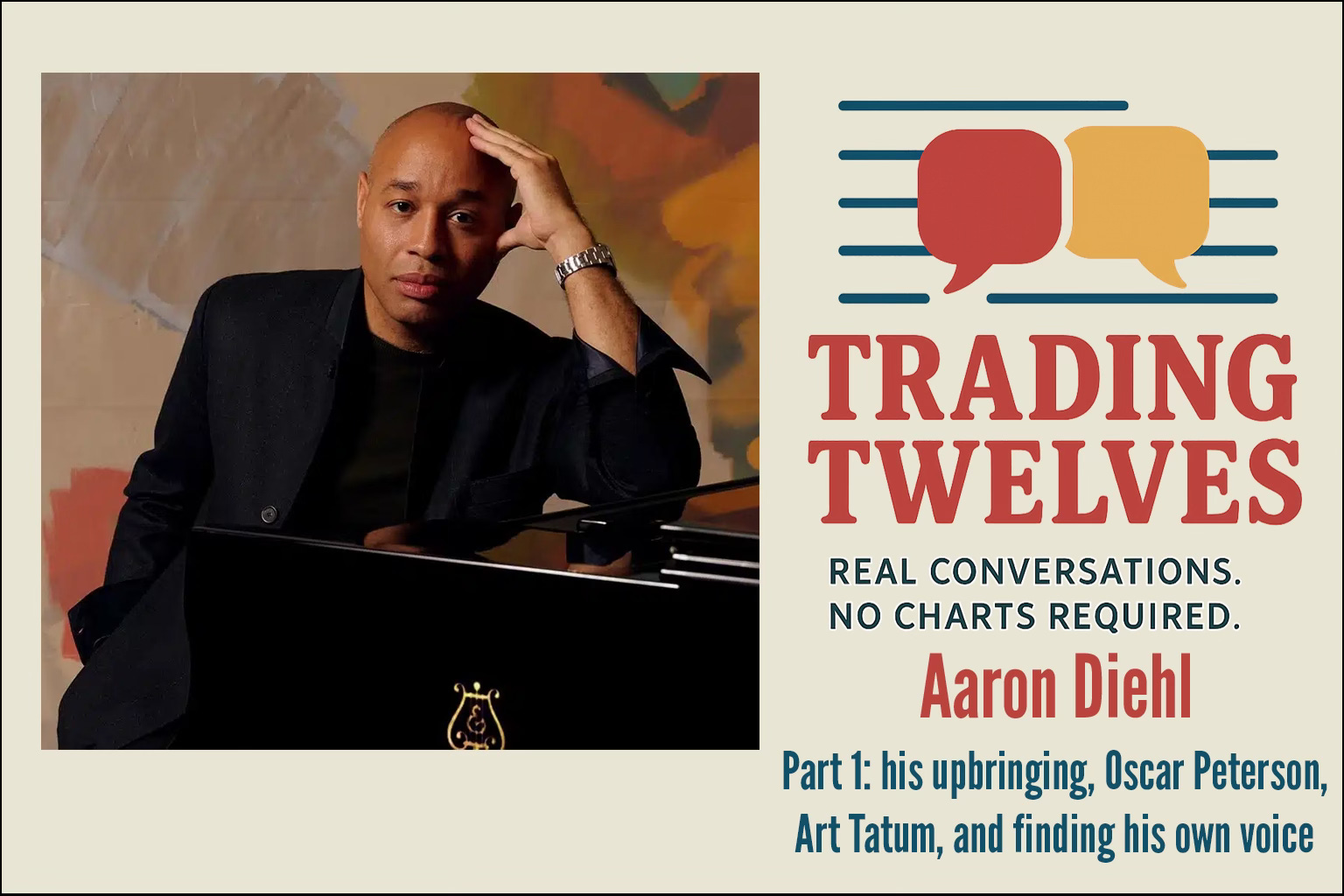
A Conversation with Aaron Diehl Part 1
Pianist Aaron Diehl discusses his upbringing, Oscar Peterson, Art Tatum, and finding your own voice in jazz
When I was a child, not long after I first met Marcus Roberts, I heard a rumor about an eighteen-year-old pianist at Juilliard who could play Art Tatum’s rendition of “Tiger Rag”. To me, anyone who could play stride at that level bordered on mythical. That pianist turned out to be Aaron Diehl.
Years later, after we had gotten to know each other, Aaron invited me to collaborate with him through the American Composers Orchestra’s Connecting ACO Community initiative. The result was J-Walking, my homage to our mutual mentor Marcus Roberts and the great lineage of stride pianists from James P. Johnson to Jaki Byard.
Below is the first of a two-part interview with Aaron, in which we explore his evolution as an artist: how a classically trained pianist from Columbus, Ohio became one of the most distinctive voices in jazz by embracing improvisation, lineage, and the pursuit of a musical identity uniquely his own.
Q: When I first met you back when I was a kid I remembered being really impressed by your playing. I think the way I found out about you was that I was told you were a young pianist who could play Art Tatum’s rendition of “Tiger Rag”. Anyone who could play ragtime or stride was impressive to me at that age. Can you explain a little bit your musical background and how you came to playing jazz piano?
Aaron:
I remember meeting you back in the early 2000s. In fact, I remember you playing some Jelly Roll Morton if I recall the rehearsals I audited at Jazz at Lincoln Center. Anyway, my own background with jazz, I really have to owe to my grandfather. His name was Arthur Baskerville. His main instrument was trombone, but by the time I was born, he was in his late 60s, early 70s, he had lost the ability to play the trombone. He primarily played gigs around town occasionally on keyboard. I was fortunate to be in a community and environment in Columbus, Ohio, where there was a vibrant jazz scene.
My grandfather also served in the Lockbourne Airforce Base band along with three other musicians who you might have heard of. One was Elvin Jones. Another was Dwike Mitchell, who was a pianist. And he had a famous duet with a bassist, Willie Ruff.
I had already through my grandfather been exposed from a young age to this dynamic world of what we call jazz. There was a Saturday Brunch jam session called “Jazz and Eggs” at a place called the Marble Gang which was hosted by a saxophonist Gene Walker. Sometimes my grandfather would participate in the jam session either to sit in or as part of the house band. I remember as a kid, my mom would sometimes take me to the jam session.
Later on when I started playing formally when I was around 7 years old, one of the gentlemen who played in the house band who was a drummer, a really nice guy called Billy Brown, he would encourage me to come up and play. And I never wanted to play. I was too shy. I felt like I didn’t have the tools available to be able to sit in and play a tune.
Q: From what I understand you started out with classical right?
Aaron:
Exactly.
Q: Were you comfortable improvising at that time?
Aaron:
No. And it’s funny. Later on when I started to entertain the idea of improvisation, since I really wasn’t into jazz music until I was a teenager, one of the records that drew my attention was Marcus Roberts’ Gershwin for Lovers. I had a Gershwin book, and I’d look at “Summertime” in its raw form and then listen to Marcus Roberts’ version and think, “Well this is not what is written!” I wondered how someone could come to make a version like that with what I’m looking at on the page.
Q: You and I had a similar experience. For me it was Joy of Joplin .
Aaron:
Yeah! I think it’s a very powerful moment when you see the expansiveness of music and how it can blossom into another entity all together in just one tune, depending on who’s playing it. So that was the seed of my fascination.
Later on, my grandfather would encourage me to sit in when I was around 12 or 13. I would go through Todd Stoll’s Columbus Youth Jazz Orchestra and even later, I would go on to meet Wynton Marsalis and Marcus Roberts.
There’s another guy who was very important in my nascent years of development which was Mark Flugge. He was someone who saw, when I was around 13, that I had a perpetual fascination with Oscar Peterson. His mission early on was for me to listen to other musicians. He had a listening list, everything from Bill Evans’ Alone to Erroll Garner’s Concert by the Sea. There was some Lennie Tristano on there. Duke Ellington’s Piano Reflections was on there. He was incredibly vital in my early years to expanding my listening palette and being exposed to other approaches to piano.
Q: What was it about Oscar Peterson that captured you?
Aaron:
That’s a good question. It’s something I’ve had conversations at length about with other pianists. There’s something about Oscar Peterson that is so attractive. There’s a technical aspect of it, especially in his recordings from The London House in the early 60s, like “On Green Dolphin Street” and “Tricotism” or “Blues Etude”. They would just be so virtuosic. For many musicians there’s just something so attractive about playing with that kind of facility and execution. At my stage in development now, I’m trying to cut away at the fat of all the things I do. But at 14, all I wanted was to be able to play like that.
There’s a famous recording that Oscar Peterson did for HGBS Label, one being My Favorite Instrument. Interestingly enough I have an autographed copy of this CD. I went to hear Oscar at the Blue Note back in 2003 and I had him sign it. I remember trying to transcribe by ear, a lot of the songs, specifically “Take the A Train” and “Perdido”. I think that style with that hard driving swing. The swing is right in your face with Oscar. In combination with the virtuosity, there’s something about it that’s very intoxicating. It’s almost like eating sugar.
Q: If you talk to Oscar, he’d say that kind of swing came from Nat King Cole.
Aaron:
Of course, Nat Cole. I didn’t really investigate Nat Cole. I had heard his records singing later, but his piano records, especially with the guitar trio, I hadn’t heard those until much later. And it became very apparent that this was Oscar Peterson’s influence.
Art Tatum was also someone whose playing I got to know around that time. And even with Art Tatum playing as virtuosic as it was, it was much harder for me to digest. The feeling of the music wasn’t always as apparent as it was in Oscar’s playing. The complexities in Tatum’s playing harmonically, phrasing over the bars, was harder for me to digest than the cut to the chase approach that Oscar took. It was also much more simplistic. I don’t say this demeaningly, but it was much more simplistic harmonically.
You mention “Tiger Rag”. There are many more recordings that Tatum made of different tunes that are very sophisticated harmonically and “Tiger Rag” really isn’t one of those. Though it’s very impressive from a pianistic standpoint. For me at a certain point I had a certain amount of facility, and I wanted to be able to show that I could play this too.
To this day, some people have asked over the years, Bill Charlap has asked me a few times to play it in a performance context, and I don’t really get excited at the idea of playing it. First of all, it’s so hard for me to get it to a point where I feel comfortable. It’s one thing learning a transcription and being able to play it. But it’s another to actually be able to create that and improvise in that kind of context.
Q: You know what his playing reminds me of? It reminds me of 19th century classical pianists. They didn’t really play their songs exactly as written. Like there’s a transcription of Chopin playing his E flat nocturne and he’s improvising in the middle of phrases. He’s adding flourishes that weren’t really written down. But if you look at the music, you see there’s a set thing for you to play. Something about the way Art Tatum adds those little virtuosic ideas in between phrases reminds me of that.
Aaron:
Yeah! And I really think that people like Liszt and Chopin for that matter were much freer with their music than now how it’s come to be this set-in-stone, cut-and-dry, sense of what the music is. It was much more of a language.
There’s a video of Barry Harris where he’s talking about the importance of understanding music as a language. He was kind of disparaging classical musicians, which I don’t know if it’s always fair to do, but he was basically saying that if you’re playing this music, you have to understand the function of the music. He simplified it when he said, “These composers are just playing changes, and they had a certain way of playing them.” That’s an oversimplification but there is some truth to that. There is a certain harmonic underpinning and structure. Beyond that, there’s idiosyncratic embellishments and flourishes which is essentially how we approach jazz. Except in jazz, when we’re playing with other people, we’re also spontaneously reacting to them in the moment.
Going back to my early development, the idea of having the freedom to expand upon something that had already been established was enticing to me. That’s one of the reasons I took the direction I did with jazz. I still absolutely love European classical music, but the freedom of exploration and the individualistic exploration creating your own voice and identity. To me that was very intriguing. It was a combination of elements that led me to this path of exploring this idiom.
In this first conversation, Aaron traced his journey from a shy young classical pianist in Columbus to someone willing to wrestle with the complexities of Art Tatum and the lineage that shaped him. In Part 2, we’ll explore how that foundation led to his work with Mary Lou Williams’ Zodiac Suite, his evolving relationship with composers like Brahms, and his thoughts on what it means to build a meaningful career in music today, one that looks both inward and outward, honoring tradition while forging something uniquely your own.


Game recognizes game! Good job, Young Wynton!